Hahahahaha wow it's been over three years since I last touched this blog. Whoops. Well, obviously I wasn't enjoying writing the reviews I was writing, but I do hope that I can someday make this blog into something I can enjoy. So, you know, I'm going to dip my toe back into this with a post that should hopefully be more chill and more fun for me to write than an actual formal book review. All right? This is a year-in-review post to highlight some of the reads that stood out to me in 2017, using the common fanfiction format known as 5+1. (Please note: The 5 are in the order in which I read them, not the order in which I favor them.) Without further ado, here are five books I loved in 2017, and one book I hated:
1. Carry On by Rainbow Rowell
Carry On was a really exciting and fun book overall, with an assortment of well-developed and lovable characters, but the thing that made me really love this book was how satisfyingly easy the romance was. I really, really don't do well with relationship angst, and in most cases of enemies-to-lovers, there's a whole lot of people tying themselves up in unnecessary knots because oh, the person I love would never love me back, and sure, they kissed me that one time, but that was just a fluke because I know that they've always hated me and always will. (Listen, I'm not spoiling anything here, because if you know anything at all about this book, you know who the main pairing is.) And I completely expected angst here, too—I sensed the moment coming and was ready for it—but there wasn't any. NO ANGST! It was beautiful, it was wonderful, it was glorious. It was so smooth and easy and straightforward, and reading it didn't require any cringing at all, and it felt so good. I loved it.
Here is a link to my review of Carry On on Goodreads. It's not very thorough, but ah well. It does note that I recommend reading Rowell's Fangirl first, since it's a good introduction.
2. Call Me By Your Name by André Aciman
I'd wanted to read this book for a while, but finally actually did so in August since I knew that the movie adaptation would be coming out at the end of the year. And wow, I am so glad I did. This book is beautiful and striking and so vivid, and so sensual, and so intimate—so intimate that it almost made me uncomfortable at times. (Peach scene, anyone?) Mostly, though, I was enthralled, and also what I think kids these days call "hot-and-bothered." Okay, no, I'm not saying that I was turned on, but boy, I was definitely on edge, and not at all in a bad way. For the first two parts—which were primarily focused on the building of tension, and only somewhat with the release of it—especially, I was on the edge of my seat; I was prone to face-fanning and internal screaming, and I'm pretty sure I contracted a semi-permanent blush that lasted the entire four days I spent reading this book. I've honestly never read anything like it. And man, I can't wait to see the movie; it still isn't showing anywhere in my county and I'm dying.
Here is a link to my Goodreads review!
3. Eliza and Her Monsters by Francesca Zappia
This book affected me a lot more than I expected it to. It felt, to me, very true to the spirit of fandom culture, and explored depression and anxiety in a very genuine way. As someone who is quite active in fandom and has also had experience with depression, I saw a lot of my own feelings in this book, and it spoke to me on a very personal level. I've read a few books dealing with fandom before, but this is the first that really seemed appreciative of it, and its approach to mental health also felt very respectful. I was both very moved by and very satisfied with how everything in this book was addressed; I never would have predicted it, but this is probably the most important book I read in 2017.
Here is a link to my Goodreads review. (And I know I mention Fangirl in a less-than-positive way in it, which might seem strange since I recommended that book earlier in this post, so I'd just like to clarify—I did like Fangirl. I just had some problems with it as well.)
4. I Am Princess X by Cherie Priest
It still surprises me every time I think about it, but I Am Princess X was probably my second-favorite book of 2017. I'm not sure if my love for it was more or less unexpected than my love for Eliza—see, with Eliza, I didn't really expect much from it, so I was surprised to get so much; with I Am Princess X, I did have expectations, and they were mainly for a certain amount of disappointment. Reading the blurb told me exactly what story I wanted from this book, but it led me to expect a story for which I felt far less enthusiasm; I did want to read this book, but had been putting it off because of my low expectations, and the only reason I finally read it this past September was because I needed an X book to finish my 2017 Alphabet Reading Challenge. I am so glad I did. This book did end up being what I wanted it to be, not what I expected it to be, and it was such a suspenseful, exciting, thrilling ride—it pulled me in right away, and I finished it in five hours. Also I think I screamed a little bit at the end. Anyway, this book is awesome, and gee whiz I would pay so much money to see it adapted into a movie. It would be a spectacular movie.
Here is my Goodreads review. It doesn't cover much more than what I just said, though.
5. Jonathan Strange & Mr Norrell by Susanna Clarke
I started this 846-page behemoth in 2014, because it was required reading for a class I was taking, but then I dropped out of school. I'd been enjoying the book quite a lot, but in the interest of my mental health, I needed to take a huge step back from everything to do with school, and it ended up taking me three years to inch my way forward again. Since it had been so long, I had to start the book over (which was painful, as I'd gotten a full quarter of the way into it the first time), because this book is, well, dense. I don't mean that negatively, at all—I just mean that there's a heck-ton of material and a heck-ton of information, and most of that information is the kind that, when incomplete, doesn't stick so well if left in the back of my brain for three years. Now that the information is complete, though, it's sticking pretty darn well, and that's because of the world-building. This book was tied for the last place on this top five list, and it was Clarke's world-building that broke the tie—I couldn't not include her world in this post. Her book takes place during the Napoleonic Wars, in a just-slightly-alternate universe in which Northern England is positively soaked in magic. Now, Clarke could've just told her story by itself, and this still would've been a good book, but she made this book truly special by delving deeply into the world around her story—its history of magic and its magical publications, in particular. All of this supplemental information is very neatly organized into footnotes (some of which are long enough to fill multiple pages), so one could read only the regular text and still understand the story perfectly well, but then all the charm of the incredibly well-rounded world that Clarke created would be lost. The footnotes may seem daunting, but they were one of my favorite parts of this book. (And I'd just like to note: I did watch the 2015 television miniseries, and it was a fair adaptation with very appealing visuals, but it cannot hold a candle to the book. A lot of the world-building was lost in translation, and, imo, it completely ruined the ending.)
Here is my Goodreads review, but honestly, it's not very thorough at all, and is pretty much completely redundant after the big chunk you just read.
Honorable Mention: The Brides of Rollrock Island by Margo Lanagan because yes I know I'm only supposed to do five, but this is a selkie book; I have to mention it. But that's all. See my review on Goodreads for actual information.
+1. Wintersong by S. Jae-Jones
Ugh I hated this book so much; it's been over seven months and I'm still pissed off. The first half was so good??? And interesting??? Like, super intriguing and all folklore-y and motivated by familial love. I was totally into it. And then, bam, romance. Bad romance. (No, not Lady Gaga. Dammit.) The worst kind of romance! On the one hand, it was bad for the story, because the entire plot just splatted when the romance took over. On the other hand, the romance was extremely abusive and unhealthy. It made me sick to read this book, knowing how high the reviews were and that so many readers saw the main relationship as incredibly romantic, thinking that there were probably young, impressionable girls out there who would someday find themselves in abusive relationships and not realize the danger because that's what YA literature told them true romance looks like. It still scares me to see that this book (currently) has a rating of 3.61 out of 5 stars on Goodreads. It scares me that, for many teens, YA literature sets the example for what romance should look like, and this book's example is an abusive relationship.
Here is my Goodreads review, which contains a full examination of everything I hated about this book, including a (spoilery; beware) discussion of why the romance is so toxic.
ALL RIGHT, there are my top five and bottom one! I actually did have a little bit of fun writing these blurbs, thank goodness. And I'd be happy to talk about any of these books (or rant, in the case of the last one) any time; if anyone wants to know more, just drop me a comment here or on my Goodreads review pages. (I'd recommend the latter, as I don't know how alert I'll be to notifications here.) Thanks for reading, assuming you did!
Sunday, December 31, 2017

Wednesday, November 26, 2014
Strange Children
I got The Waters & the Wild by Francesca Lia Block from the library because the title is awesome, and the cover is pretty cool too. Also, it's a really short book. Like, 113 pages. And it's about changelings, which I find very exciting. So yeah. Here it is.
Bee has always been different: more interested in dirt and green things than television and celebrities, a little bit wrong-looking in many small ways, unable to connect with the people around her. Then one night a girl shows up in her bedroom, claiming that they are the same, saying that Bee stole her life and she wants it back. As she begins to investigate the appearance of this doppelgänger and the possibility that she could be a changeling, she also finally begins to make friends: an alien boy and girl who has memories from a past life as a slave. Together they find ways to connect with their worlds and explore their identities and all that usual coming-of-age stuff; what else can I say?
This was a very sweet book, with a fairly straight-forwardly told story interspersed with bits of poetry and prefaced by an enchanting "thirteen ways to know you are a changeling" list. However... well. I found it in the teen section, but I've come to realize that "teen" is a large category, and preteen/young teen books are nothing like young adult books. This book is about thirteen-year-olds, and really should be read by thirteen-year-olds. I was not as engaged in it as I would've liked.
Also, the story seemed to completely change partway through the book. The first half was about Bee, the main character, but by the end, she seemed to just be a plot device in the story of her two friends. It was very strange and didn't work for me at all.
Other than that, the imagery in this book--especially near the end, when the changeling issue was really coming to a head--was marvelous. And I liked the theme, of outcasts finding their own community, because everyone feels different at some point or another. So overall: a nice book, but not really my thing (unfortunately, since I've been dying for a good changeling story lately).
No sequels, but Block has written lots of other unrelated books, which I probably won't read but you never know. And no movie.
Recommendation: If you are a preteen or young teen who likes stories about changelings or other strange fairy-adjacent things, then you should definitely read this book! If you like interesting takes on the usual coming-of-age theme, or stories about people who don't fit in, go for it! And even if you are older, if you are at all curious about or interested in some of these themes and tropes, try it out! It's a short book, so even if you don't like it, it won't take too much of your time.
Warning: This books is fairly tame (especially in comparison to the last book I reviewed), but there are references slavery and some mild (in my opinion) instances of bullying. Those are the only possible triggers I can think of.
Rating: Three stars. Maybe 3.5? Eh.
 |
| The Waters & the Wild by Francesca Lia Block |
Bee has always been different: more interested in dirt and green things than television and celebrities, a little bit wrong-looking in many small ways, unable to connect with the people around her. Then one night a girl shows up in her bedroom, claiming that they are the same, saying that Bee stole her life and she wants it back. As she begins to investigate the appearance of this doppelgänger and the possibility that she could be a changeling, she also finally begins to make friends: an alien boy and girl who has memories from a past life as a slave. Together they find ways to connect with their worlds and explore their identities and all that usual coming-of-age stuff; what else can I say?
This was a very sweet book, with a fairly straight-forwardly told story interspersed with bits of poetry and prefaced by an enchanting "thirteen ways to know you are a changeling" list. However... well. I found it in the teen section, but I've come to realize that "teen" is a large category, and preteen/young teen books are nothing like young adult books. This book is about thirteen-year-olds, and really should be read by thirteen-year-olds. I was not as engaged in it as I would've liked.
Also, the story seemed to completely change partway through the book. The first half was about Bee, the main character, but by the end, she seemed to just be a plot device in the story of her two friends. It was very strange and didn't work for me at all.
Other than that, the imagery in this book--especially near the end, when the changeling issue was really coming to a head--was marvelous. And I liked the theme, of outcasts finding their own community, because everyone feels different at some point or another. So overall: a nice book, but not really my thing (unfortunately, since I've been dying for a good changeling story lately).
No sequels, but Block has written lots of other unrelated books, which I probably won't read but you never know. And no movie.
Recommendation: If you are a preteen or young teen who likes stories about changelings or other strange fairy-adjacent things, then you should definitely read this book! If you like interesting takes on the usual coming-of-age theme, or stories about people who don't fit in, go for it! And even if you are older, if you are at all curious about or interested in some of these themes and tropes, try it out! It's a short book, so even if you don't like it, it won't take too much of your time.
Warning: This books is fairly tame (especially in comparison to the last book I reviewed), but there are references slavery and some mild (in my opinion) instances of bullying. Those are the only possible triggers I can think of.
Rating: Three stars. Maybe 3.5? Eh.
Monday, October 13, 2014
Science and Faith (and Murder, Oh My!)
I went back and forth about whether or not to blog about the third book in my library stack, The Waking Dark by Robin Wasserman, but by the time I finished it, I knew I had to. It was just so crazy and intense and dark and also not what I was expecting in multiple ways. I don't feel like writing some in-depth introduction so that's all you're gonna get before the actual review.
Actually, it's not. See, I wrote that paragraph when I first attempted to blog about this book a few months ago, and now a few months have passed and there's a lot more that I need to say.
First of all, yes. I'm a total fail at this. I said I was back on this blog and I didn't follow through. There are a few different reasons for this, only two of which are worth mentioning: A) There were a fair number of activities on which I was--to my great shame--more interested in spending my time than this blog. B) The idea of blogging about this book was very... daunting.
Second of all, this book affected me a lot more than I originally realized. I noticed within the first chapter that the relationship between two of the characters was startlingly similar to the relationship between two of my characters--my original characters. As the book continued, the similarities grew, enough so that I felt a very strong emotional attachment to that relationship--and that strong emotional attachment eventually led to me having dreams about it. I dreamt multiple times about the two characters from this book and my own two characters, sometimes with all four of them together and sometimes with just two characters who were sort of fusions of the book's and mine. This is, of course, what made--makes--blogging about this book daunting. Since finishing it, I've found myself thinking about and re-exploring it quite a lot, and I've realized that it's actually pretty important to me. I don't want to not do it justice.
But I want even less to not share it with the world, so here I am. Hopefully my second attempt at this post will be more successful than my first.
...Okay, here's the hard part. There's a reason I stopped before the summary last time. How on earth do I summarize this book??? Seriously???
Okay.
On one day, in just a few hours, five citizens of Oleander, Kansas become killers. For no discernible reason, these seemingly normal members of this community kill everyone around them and then themselves. Only one of the five fails in her attempt at the latter, but even she can provide no explanation for the reeling town.
One year after the Killing Day, a storm hits Oleander, and everything falls apart. The town is ravaged and then quarantined--a precaution necessitated by the storm's destruction of a nearby "facility"--and previously upstanding citizens begin to take the law into their own hands. Only five survivors of the Killing Day seem immune to the bloodlust that is infecting the town, so only these five can save it--as long as they can save themselves.
And that's all you get, because I don't know what else to say.
As I explained previously, this book had a surprisingly significant affect on me. Even excluding my personal attachment to certain characters and relationships, it's kind of really incredible. The writing is seriously compelling, the characters are all very real and relatable and impossible not to feel for, and the twists are some of the most shockingly unpredictable that I've ever read. Robin Wasserman builds the suspense and real darkness in this book masterfully; this is a true psychological thriller if I've ever read--or seen--one. Honestly, some of the acts committed by the inhabitants of Oleander are actually breathtakingly horrifying. Also, the question-themes of science and faith (hence my title) are so interesting to explore, especially in the ways that they affect each character differently, and have the potential to irrevocably affect so much more.
On all counts, this book is stunning: stunningly dark, and just plaining stunning in general.
There is no sequel to The Waking Dark, of which I am very glad. It ended well, and any attempt to continue it would seem false. Robin Wasserman has written a fair number of other books, however, which will definitely be going on my to-read list. I hope more of them are in this same genre, because she is a master of it.
No news of a movie so far, which is a shame. Assuming they did it justice, this book would make a brilliant movie. Of course, it would probably be rated R for violence and sexual themes (and definitely language), but if it weren't, it wouldn't be true to the book... Which leads me to the realization that I should probably have a warnings section in this post, if not all of my posts. After the recommendations section, I think.
Recommendation: This is a very, very dark book. So beware. But if you like dark books, and horror, and psychological thrills, and really twisted people doing really twisted things (and getting really twisted things done to them), then do not miss this book! I've not read much horror, but a lot of people on Goodreads say that The Waking Dark is in the same vein as Stephen King's writing, so if you're a fan of him, you should definitely give this one a try. Seriously, though. It's... just, wow.
Warning: This book contains a lot of violence--a lot--and much of it seems pretty senseless (within Oleander, not within the book; all the violence in the book is definitely there for a reason). And this book is, in nearly all areas, explicit. The violence is primarily--but not only--executed with guns and knives. There is a lot of blood, some creepy sexual themes, the on- and off-page murders of many innocent (and not innocent) people including one infant, violence committed by and against a child, at least six cases of suicide/attempted suicide, at least two cases of rape/attempted rape, two instances of people being burnt alive, references to military occupation and violence, martyrdom, hate crimes, beatings, a fair amount of drug usage, strong and suggestive language, slut-shaming, both internalized and violently externalized homophobia, both implicit and explicit insanity (and institutionalization for it), bad weather, nonconsensual experimentation i.e. the violation of agency... and more. IF ANY OF THESE THINGS COULD BE POTENTIALLY TRIGGERING FOR YOU, I URGE YOU TO AVOID THIS BOOK. If you're unsure about anything I've mentioned here, feel free to comment on this post/message me/whatever and I'll be happy to provide clarification.
I've also decided to include an actual ratings section in my posts, and I'll go back to at least some of my past posts to add this. You'll find an explanation of my system at the top of the right sidebar. Ergo:
Rating: Five stars. Originally I gave it four stars, but the lasting affect it had on me was cause for a promotion.
Actually, it's not. See, I wrote that paragraph when I first attempted to blog about this book a few months ago, and now a few months have passed and there's a lot more that I need to say.
First of all, yes. I'm a total fail at this. I said I was back on this blog and I didn't follow through. There are a few different reasons for this, only two of which are worth mentioning: A) There were a fair number of activities on which I was--to my great shame--more interested in spending my time than this blog. B) The idea of blogging about this book was very... daunting.
Second of all, this book affected me a lot more than I originally realized. I noticed within the first chapter that the relationship between two of the characters was startlingly similar to the relationship between two of my characters--my original characters. As the book continued, the similarities grew, enough so that I felt a very strong emotional attachment to that relationship--and that strong emotional attachment eventually led to me having dreams about it. I dreamt multiple times about the two characters from this book and my own two characters, sometimes with all four of them together and sometimes with just two characters who were sort of fusions of the book's and mine. This is, of course, what made--makes--blogging about this book daunting. Since finishing it, I've found myself thinking about and re-exploring it quite a lot, and I've realized that it's actually pretty important to me. I don't want to not do it justice.
But I want even less to not share it with the world, so here I am. Hopefully my second attempt at this post will be more successful than my first.
 |
| The Waking Dark by Robin Wasserman |
...Okay, here's the hard part. There's a reason I stopped before the summary last time. How on earth do I summarize this book??? Seriously???
Okay.
On one day, in just a few hours, five citizens of Oleander, Kansas become killers. For no discernible reason, these seemingly normal members of this community kill everyone around them and then themselves. Only one of the five fails in her attempt at the latter, but even she can provide no explanation for the reeling town.
One year after the Killing Day, a storm hits Oleander, and everything falls apart. The town is ravaged and then quarantined--a precaution necessitated by the storm's destruction of a nearby "facility"--and previously upstanding citizens begin to take the law into their own hands. Only five survivors of the Killing Day seem immune to the bloodlust that is infecting the town, so only these five can save it--as long as they can save themselves.
And that's all you get, because I don't know what else to say.
As I explained previously, this book had a surprisingly significant affect on me. Even excluding my personal attachment to certain characters and relationships, it's kind of really incredible. The writing is seriously compelling, the characters are all very real and relatable and impossible not to feel for, and the twists are some of the most shockingly unpredictable that I've ever read. Robin Wasserman builds the suspense and real darkness in this book masterfully; this is a true psychological thriller if I've ever read--or seen--one. Honestly, some of the acts committed by the inhabitants of Oleander are actually breathtakingly horrifying. Also, the question-themes of science and faith (hence my title) are so interesting to explore, especially in the ways that they affect each character differently, and have the potential to irrevocably affect so much more.
On all counts, this book is stunning: stunningly dark, and just plaining stunning in general.
There is no sequel to The Waking Dark, of which I am very glad. It ended well, and any attempt to continue it would seem false. Robin Wasserman has written a fair number of other books, however, which will definitely be going on my to-read list. I hope more of them are in this same genre, because she is a master of it.
No news of a movie so far, which is a shame. Assuming they did it justice, this book would make a brilliant movie. Of course, it would probably be rated R for violence and sexual themes (and definitely language), but if it weren't, it wouldn't be true to the book... Which leads me to the realization that I should probably have a warnings section in this post, if not all of my posts. After the recommendations section, I think.
Recommendation: This is a very, very dark book. So beware. But if you like dark books, and horror, and psychological thrills, and really twisted people doing really twisted things (and getting really twisted things done to them), then do not miss this book! I've not read much horror, but a lot of people on Goodreads say that The Waking Dark is in the same vein as Stephen King's writing, so if you're a fan of him, you should definitely give this one a try. Seriously, though. It's... just, wow.
Warning: This book contains a lot of violence--a lot--and much of it seems pretty senseless (within Oleander, not within the book; all the violence in the book is definitely there for a reason). And this book is, in nearly all areas, explicit. The violence is primarily--but not only--executed with guns and knives. There is a lot of blood, some creepy sexual themes, the on- and off-page murders of many innocent (and not innocent) people including one infant, violence committed by and against a child, at least six cases of suicide/attempted suicide, at least two cases of rape/attempted rape, two instances of people being burnt alive, references to military occupation and violence, martyrdom, hate crimes, beatings, a fair amount of drug usage, strong and suggestive language, slut-shaming, both internalized and violently externalized homophobia, both implicit and explicit insanity (and institutionalization for it), bad weather, nonconsensual experimentation i.e. the violation of agency... and more. IF ANY OF THESE THINGS COULD BE POTENTIALLY TRIGGERING FOR YOU, I URGE YOU TO AVOID THIS BOOK. If you're unsure about anything I've mentioned here, feel free to comment on this post/message me/whatever and I'll be happy to provide clarification.
I've also decided to include an actual ratings section in my posts, and I'll go back to at least some of my past posts to add this. You'll find an explanation of my system at the top of the right sidebar. Ergo:
Rating: Five stars. Originally I gave it four stars, but the lasting affect it had on me was cause for a promotion.
Monday, April 21, 2014
"Tell Me a Story."
The first book I'm going to review after my very long hiatus is one of the best books I've read in a very long time. It's also one of the only books I've read in a very long time, but that is beside the point.
Here's what happened: I was out on a walk, because I'm meant to get some form of exercise every day and I didn't realize I could do so without leaving the house and whilst watching TV just by using my dad's electric bike until like a week later, and I thought, "WHAT THE HECK. I'LL GO TO THE LIBRARY." So I did. And see the thing about me is that all my bookshopping is done in a very special way: I go to a bookstore (or library), look at all the books with pretty covers and interesting titles in the YA section, and take home the two-to-five that most pique my interest, even if that means I'm spending like seventy bucks in one go. (It's a dangerous lifestyle, but hey, Danger is my middle name.) (That was a lie. Danger is just my nickname.) (That was also a lie. Danger is a word that is starting to look very strange to me, and that is all.) On this particular day, I went to the library with comfortably empty arms and left with a giant stack of hard-cover books. (I only got four books, so the stack wasn't really giant, but I had two more blocks to walk and nothing to carry them in so it was all very awkward.) The first book I read was good, but I'm not going to blog about it, because it wasn't amazing and I just don't feel like it. This is the second.
Otter was born to be a binder, to tie the knots that protect the Shadowed People from the dead. Her mother, Willow, is the greatest binder since Mad Spider, and Otter has inherited that power. Her friend Kestrel is training to be a ranger, one of the brave women who venture beyond the protection of the ward; Cricket, a boy in a world where men aren't safe, has a knack for storytelling. These three friends know where they belong in Westmost, their forest village, and they are happy.
But there are worse dangers than the little dead that live in shadows: A White Hand is lurking in the forest, putting all of the Shadowed People in fear of a touch that breeds madness. Meanwhile, the old binder has died, leaving Westmost in the hands of Willow, whose power seems to be turning inside out. In a very short time, everything goes wrong, and Otter is faced with impossible choices, terrible grief, and the growing knowledge that, as Willow says: There is something wrong with the knots.
This book, just, wow. Everything about it is incredible, and unique. The language is precise, formal yet natural, and the writing is so gloriously rich with vivid imagery that even the intangible--the clotting shadows of the dead, the electric power of the wards, and all the true physicalities of emotions--becomes undoubtably real. The characters are complex and compelling, and completely believable--as is the world that Bow created, which is beautiful and horrifying at the same time. One of my favorite things about this world is its stories, which are hugely significant; one of my favorite things about this book is how the characters had to trace back to the roots of their stories in order to understand what they were facing. There was something very exhilarating about that. The whole book was exhilarating, really, and very eerie, and Bow wove suspense impressively well; I haven't been so desperate to finish a book in quite a while. At the same time, I wish it hadn't ended, because it was so incredible, and I really enjoyed the time I spent consumed by it.
What's really cool about this book is that the story ends, but a new character is introduced, and he has a story that is just beginning. I have a feeling that Erin Bow will not be writing his story, which would really be more of a companion to Sorrow's Knot than a sequel, and I'm sort of glad of that, because I think it's nice to leave the imagining of it up to the reader. At the same time, I really really really do want her to write it, because I want so much more of this world. Meanwhile, I'm pretty sure there's nothing that could stop me from reading her first book, Plain Kate, as well as her third, Children of Peace, though the latter won't be out for another two years. Her writing is just so amazing, and I'm really curious to see how it changes when she writes about different worlds.
As far as I can tell, there is no movie in the works for Sorrow's Knot. I think I'm glad of that. As much as I'd love to experience the world about which I keep waxing poetic in full audio-visual form, I can't imagine it being captured as perfectly in such a form as it is in its original. I like it as a book.
Thanks... to the library, I guess. This thanks section is kind of weird, isn't it? I'm not sure I'll keep it.
Recommendation: This isn't a happy book, so don't read this if you only like happy books. Otherwise, if you have an appreciation for great world-building and intricate mythologies, like I do, then definitely read this. Also, if you want strong female characters, because two of the main characters are female and very strong, and their whole society is probably like 90% women, all of whom are strong in their own ways. If you like stories about stories, this is a good choice. If you want your breath taken away--in all the ways, but especially all the best ways--then this, my friend, is a must-read for you. Read it. Yes. You. Read. Read it. Readdddddd it.
Rating: Five stars.
Here's what happened: I was out on a walk, because I'm meant to get some form of exercise every day and I didn't realize I could do so without leaving the house and whilst watching TV just by using my dad's electric bike until like a week later, and I thought, "WHAT THE HECK. I'LL GO TO THE LIBRARY." So I did. And see the thing about me is that all my bookshopping is done in a very special way: I go to a bookstore (or library), look at all the books with pretty covers and interesting titles in the YA section, and take home the two-to-five that most pique my interest, even if that means I'm spending like seventy bucks in one go. (It's a dangerous lifestyle, but hey, Danger is my middle name.) (That was a lie. Danger is just my nickname.) (That was also a lie. Danger is a word that is starting to look very strange to me, and that is all.) On this particular day, I went to the library with comfortably empty arms and left with a giant stack of hard-cover books. (I only got four books, so the stack wasn't really giant, but I had two more blocks to walk and nothing to carry them in so it was all very awkward.) The first book I read was good, but I'm not going to blog about it, because it wasn't amazing and I just don't feel like it. This is the second.
 |
| Sorrow's Knot by Erin Bow |
Otter was born to be a binder, to tie the knots that protect the Shadowed People from the dead. Her mother, Willow, is the greatest binder since Mad Spider, and Otter has inherited that power. Her friend Kestrel is training to be a ranger, one of the brave women who venture beyond the protection of the ward; Cricket, a boy in a world where men aren't safe, has a knack for storytelling. These three friends know where they belong in Westmost, their forest village, and they are happy.
But there are worse dangers than the little dead that live in shadows: A White Hand is lurking in the forest, putting all of the Shadowed People in fear of a touch that breeds madness. Meanwhile, the old binder has died, leaving Westmost in the hands of Willow, whose power seems to be turning inside out. In a very short time, everything goes wrong, and Otter is faced with impossible choices, terrible grief, and the growing knowledge that, as Willow says: There is something wrong with the knots.
This book, just, wow. Everything about it is incredible, and unique. The language is precise, formal yet natural, and the writing is so gloriously rich with vivid imagery that even the intangible--the clotting shadows of the dead, the electric power of the wards, and all the true physicalities of emotions--becomes undoubtably real. The characters are complex and compelling, and completely believable--as is the world that Bow created, which is beautiful and horrifying at the same time. One of my favorite things about this world is its stories, which are hugely significant; one of my favorite things about this book is how the characters had to trace back to the roots of their stories in order to understand what they were facing. There was something very exhilarating about that. The whole book was exhilarating, really, and very eerie, and Bow wove suspense impressively well; I haven't been so desperate to finish a book in quite a while. At the same time, I wish it hadn't ended, because it was so incredible, and I really enjoyed the time I spent consumed by it.
What's really cool about this book is that the story ends, but a new character is introduced, and he has a story that is just beginning. I have a feeling that Erin Bow will not be writing his story, which would really be more of a companion to Sorrow's Knot than a sequel, and I'm sort of glad of that, because I think it's nice to leave the imagining of it up to the reader. At the same time, I really really really do want her to write it, because I want so much more of this world. Meanwhile, I'm pretty sure there's nothing that could stop me from reading her first book, Plain Kate, as well as her third, Children of Peace, though the latter won't be out for another two years. Her writing is just so amazing, and I'm really curious to see how it changes when she writes about different worlds.
As far as I can tell, there is no movie in the works for Sorrow's Knot. I think I'm glad of that. As much as I'd love to experience the world about which I keep waxing poetic in full audio-visual form, I can't imagine it being captured as perfectly in such a form as it is in its original. I like it as a book.
Thanks... to the library, I guess. This thanks section is kind of weird, isn't it? I'm not sure I'll keep it.
Recommendation: This isn't a happy book, so don't read this if you only like happy books. Otherwise, if you have an appreciation for great world-building and intricate mythologies, like I do, then definitely read this. Also, if you want strong female characters, because two of the main characters are female and very strong, and their whole society is probably like 90% women, all of whom are strong in their own ways. If you like stories about stories, this is a good choice. If you want your breath taken away--in all the ways, but especially all the best ways--then this, my friend, is a must-read for you. Read it. Yes. You. Read. Read it. Readdddddd it.
Rating: Five stars.
Sunday, April 20, 2014
HONEY, I'M HOME!
So.
It’s been over two years since my last post, nearly three
since my last actual book review. This is partly because my reviews are long, and consume a lot of time that I often don’t have;
it is mainly because for the last year or two, I haven’t been reading books. I
haven’t stopped reading—in fact, I’ve probably been reading more—but I’ve been reading fanfiction instead. Which. I mean,
that’s not really something I can review on here. But anyways, I’ve started
reading books again, and I’m trying to balance my fanfiction with my books
because omg there is just so much stuff that I want to read.
So I’ve started reading books again and I’ve decided to
start blogging about them again, too. I’m not going to blog about all of them,
because I just don’t want to, and I also will probably change my format a bit,
since honestly I just don’t even remember the formula I used when constructing
my posts three years ago. This started out as something that would look good on college
apps and as something for me to write about in college essays, so it wasn’t
really for me, but now it’s going to be.
I’m going to change some stuff and do some stuff differently and generally just
shape my activity on this blog so that it’s something that I enjoy, that I do
for myself. Hopefully that will lead me to be more active on here.
Honestly the readership on this is so low that I doubt
anyone cares, but without further ado…
I’M BACK!
…Expect a review soon :)
Saturday, January 7, 2012
About Writing, and a Contest
It's been a while since I last posted. A long while. I blame college apps. And homework. And school, for that matter. But mainly college apps. I'm done with college apps now, though, so hopefully I'll have time to post again. I haven't gotten to read much either, sadly. However, I decided to pop in at the end of my winter break here to rave about a particular other blog (and, in the process, inter a competition). I know I'm technically not reviewing a book, so I don't blame you if you don't read this. But it is the blog of an author I'm a fan of, so maybe you'll find this interesting. I don't know. Also, it's still, like, a review. Just of an author's blog instead of an author's book. Anyways.
Maggie Stiefvater is the fairly (aka very) well-known author of the Wolves of Mercy Falls trilogy. I read the first book, Shiver, near the end of the summer, and that's one of the next books I'll be blogging about. It's good. I intend to read the others quite soon. But that is not why I am here. I am here because Maggie's blog is amazing.
Now, this contest I'm entering, which is to decide the recipient of a beautiful stack of thirty-five (if I counted right) books that Maggie is giving up. I want these books. Basically, I need to talk about my favorite of all of her posts. Obviously, I am doing a bit more than that. That's not because I'm hoping that praising her and her blog to no end will give me a better chance. It's just because I am the kind of person who goes all out. Especially for these kinds of things. And I didn't want to post some half-baked homage to some random entry of some random lady's blog. I wanted to post a complete and ready-to-serve explanation, description, and analysis of a relevant entry of an inspiring author named Maggie Stiefvater's blog. So that is what you, dear readers, are going to get. If you exist. And if you keep reading.
My favorite post is a fairly recent one titled "Writing the Book I Always Meant To." It's about her newest book, The Scorpio Races, which I absolutely must read. It revolves around one certain piece of advice that she received when she was a teen and is now passing on to us: "write the book you've always wanted to read, but can't find on the shelf." It's also about how she has spent her whole life (pretty much) trying to follow this advice, and how she has finally succeeded.
So, whether I win that gorgeous stack of thirty-five splendid books or not, I thank you, Maggie Stiefvater. Your blog has given me a lot to learn, a lot to be inspired by, and a lot to work towards. And this one post, especially, has shown me that someday, everything I do for my writing will pay off, and my writing will finally be exactly where I want it to be. Basically, you have shown me the light at the end of the tunnel. ...Too morbid? Okay, the silver lining then. You have shown me the brilliant, pure silver lining of this massively large, dark, and oddly-shaped cloud that I think may start raining on me at any moment. Now, if you don't mind, I'm going to go fetch an umbrella.
UPDATE: Well, it turns out I missed the deadline for this contest, but oh well. This still needed to be said. I think I'll go try to find a way to get Maggie to read this anyways, because, well, I suppose I just want her to know how that post affected me.
First of all, she's hilarious. Just the way she puts everything together, the analogies she makes (and she loves analogies), even the topics she writes about. But that's not why I'm blogging about this. I'm blogging about this because I'm a writer, and many of her posts discuss how she writes and contain good advice for aspiring writers.
Last night I went through her "how I write" tag and read about ten of such posts. I had already read a few, because Goodreads tells me when she blogs, but I've still only read a fraction of them. I would've read more last night, but these posts are fairly long and very thorough, so the ten-ish that I read took up most of my primetime evening (especially since my mom was watching clips of Jimmy Fallon next to me so, naturally, I was multitasking). And then I was really tired so I went to bed.
The thing is, her explanations on how to write - or, how she writes, and how one may approach writing when stuck - are usable. She answers the questions that we aspiring writers all want to know, and she answers them in ways we can understand. Though most of her advice relates to longer pieces, such as novels, it is relevant to all aspects of writing. And though obviously her blog and Jimmy Fallon meant that I had no time to write my own stuff last night, I can't wait to try out some of her techniques and put some of her advice to good use.
First of all, I think that is amazing advice. It's the kind of thing I never would have thought of by myself, but now that I've seen it, it's so obvious. I think that this is the kind of advice that will give you something you are truly passionate about and, when you have completed it, can be proud of. I want to do this. Which means I need to really think about what I want out of the books I read, and put that into my writing.
So... a love triangle that won't let me choose a side, like I talked about in my last post. And maybe a boyband or two.
I jest.
(Except not really.)
(I'll explain.)
(But not now.)
Second of all, Maggie talks about all her attempts to write this book. Because no, she did not one day think, "I know. I know what I want to read; I know what to write," and then go do it. No, she tried to write this book in her teens, at the beginning of her (adult) writing career, in the middle of said career, in the later middle of said career... Many times. She tried to write the book she wanted to read over and over and over again, but never got it exactly right. But after all of these attempts, and after writing many other books and stories, she finally found everything she needed to write this book, most importantly her own - 100% Maggie - style. So this time, she got it right. One of my favorite paragraphs of the post (yes, I am going to quote, just like the good little English student and practiced essay writer that I am) is as follows:
I can't wait.
Maggie Stiefvater is the fairly (aka very) well-known author of the Wolves of Mercy Falls trilogy. I read the first book, Shiver, near the end of the summer, and that's one of the next books I'll be blogging about. It's good. I intend to read the others quite soon. But that is not why I am here. I am here because Maggie's blog is amazing.
Now, this contest I'm entering, which is to decide the recipient of a beautiful stack of thirty-five (if I counted right) books that Maggie is giving up. I want these books. Basically, I need to talk about my favorite of all of her posts. Obviously, I am doing a bit more than that. That's not because I'm hoping that praising her and her blog to no end will give me a better chance. It's just because I am the kind of person who goes all out. Especially for these kinds of things. And I didn't want to post some half-baked homage to some random entry of some random lady's blog. I wanted to post a complete and ready-to-serve explanation, description, and analysis of a relevant entry of an inspiring author named Maggie Stiefvater's blog. So that is what you, dear readers, are going to get. If you exist. And if you keep reading.
My favorite post is a fairly recent one titled "Writing the Book I Always Meant To." It's about her newest book, The Scorpio Races, which I absolutely must read. It revolves around one certain piece of advice that she received when she was a teen and is now passing on to us: "write the book you've always wanted to read, but can't find on the shelf." It's also about how she has spent her whole life (pretty much) trying to follow this advice, and how she has finally succeeded.
So, whether I win that gorgeous stack of thirty-five splendid books or not, I thank you, Maggie Stiefvater. Your blog has given me a lot to learn, a lot to be inspired by, and a lot to work towards. And this one post, especially, has shown me that someday, everything I do for my writing will pay off, and my writing will finally be exactly where I want it to be. Basically, you have shown me the light at the end of the tunnel. ...Too morbid? Okay, the silver lining then. You have shown me the brilliant, pure silver lining of this massively large, dark, and oddly-shaped cloud that I think may start raining on me at any moment. Now, if you don't mind, I'm going to go fetch an umbrella.
UPDATE: Well, it turns out I missed the deadline for this contest, but oh well. This still needed to be said. I think I'll go try to find a way to get Maggie to read this anyways, because, well, I suppose I just want her to know how that post affected me.
First of all, she's hilarious. Just the way she puts everything together, the analogies she makes (and she loves analogies), even the topics she writes about. But that's not why I'm blogging about this. I'm blogging about this because I'm a writer, and many of her posts discuss how she writes and contain good advice for aspiring writers.
Last night I went through her "how I write" tag and read about ten of such posts. I had already read a few, because Goodreads tells me when she blogs, but I've still only read a fraction of them. I would've read more last night, but these posts are fairly long and very thorough, so the ten-ish that I read took up most of my primetime evening (especially since my mom was watching clips of Jimmy Fallon next to me so, naturally, I was multitasking). And then I was really tired so I went to bed.
The thing is, her explanations on how to write - or, how she writes, and how one may approach writing when stuck - are usable. She answers the questions that we aspiring writers all want to know, and she answers them in ways we can understand. Though most of her advice relates to longer pieces, such as novels, it is relevant to all aspects of writing. And though obviously her blog and Jimmy Fallon meant that I had no time to write my own stuff last night, I can't wait to try out some of her techniques and put some of her advice to good use.
First of all, I think that is amazing advice. It's the kind of thing I never would have thought of by myself, but now that I've seen it, it's so obvious. I think that this is the kind of advice that will give you something you are truly passionate about and, when you have completed it, can be proud of. I want to do this. Which means I need to really think about what I want out of the books I read, and put that into my writing.
So... a love triangle that won't let me choose a side, like I talked about in my last post. And maybe a boyband or two.
I jest.
(Except not really.)
(I'll explain.)
(But not now.)
Second of all, Maggie talks about all her attempts to write this book. Because no, she did not one day think, "I know. I know what I want to read; I know what to write," and then go do it. No, she tried to write this book in her teens, at the beginning of her (adult) writing career, in the middle of said career, in the later middle of said career... Many times. She tried to write the book she wanted to read over and over and over again, but never got it exactly right. But after all of these attempts, and after writing many other books and stories, she finally found everything she needed to write this book, most importantly her own - 100% Maggie - style. So this time, she got it right. One of my favorite paragraphs of the post (yes, I am going to quote, just like the good little English student and practiced essay writer that I am) is as follows:
And of course, finally, in chapter 46 of The Scorpio Races, I wrote the scene I'd been imagining since I was my daughter's age: a herd of water horses tearing in from an angry sea. Chapter 46 isn't a very long one, and it wasn't late when I wrote it, but after I finished the last sentence of it, I closed my computer and had to stop writing for the night. It's a weird feeling to finally do something right after doing it wrong for so many years. I knew before that that The Scorpio Races was the best thing I'd written so far, but that was when I really realized I'd written the book I'd wanted to find on the shelf all those years ago.For me, the idea of experiencing this feeling is wholly fascinating. Just the fact that she tried so many times and never gave up, never got discouraged, is inspiring. The fact that she finally reached the point where she was able to write this book goes to show that practice really does make perfect. All I hear about the world of the writer is that it is a very difficult job, that so many writers struggle and never become successful, but this. This says otherwise. I know Maggie was successful before she wrote The Scorpio Races, but that's a different kind of success. I know personally that it's so easy to become discouraged before you even try to enter the publishing world, because it's practically impossible to be truly satisfied with your own writing. But this shows that it just takes time. You have to go through so much time and effort and writing, writing, writing before you can be totally ready to create something that will complete you. And what she talks about concerning chapter 46... I feel like something like that just validates everything you've ever put into your writing, every hour, every word, every single drop of your soul that you've poured into it. When you reach that, that one moment, everything must finally click. This is why you write. This is why you go through all of this grief to write. This is why you've given up so much to write. And finally you can believe that tiny part of your heart that has been telling you all along that you made all the right decisions, and that someday you would get your reward. This, this feeling, this moment she's talking about - this is your reward. And it is worth everything.
I can't wait.
Saturday, August 20, 2011
Indecision
A few months ago, in early April, I gave my dad a short speech about how what I really wanted to read was a book in which the protagonist (who, in the majority of the books I read these days, is a girl) had to choose between two boys and I couldn't choose who my favorite was. In all the books I've ever read that feature love triangles, I've always known who I want the girl to end up with from the very beginning. For Bella, I chose Edward over Jacob; for Katniss, I chose Peeta over Gale; for Clary, I chose Jace over Simon; for Tessa, I chose Will over Jem; for Ellie, I chose Will over Gavin (and I think over Kamil, too, but I still haven't finished those and I never really got to know him); for Jacky, I chose Jamie over... well, everyone else, haha; etc. This is not to say I got them all right; maybe I did, maybe I didn't (not telling). The point is, I always knew my choice, even when the girl didn't know hers. I always knew who I wanted her to be with. After so many books in which I was never uncertain, I wanted one in which I was. I wanted a book with a love triangle, where the girl couldn't choose between two boys and I couldn't either. Less than a week later, I found one. I give you The Forest of Hands and Teeth by Carrie Ryan.
Mary has grown up listening to her mother's stories. Stories of a time, before the Return, when the Unconsecrated were not a constant danger, when the village was not an island of life in a sea of death, when there was a world outside the fences. Stories of a place called the ocean, where there is only water as far as you can see, and where the water is always moving, and where the water is filled with salt. And Mary feels restless. But the Sisterhood knows best, and it is not good to ask questions. Mary knows this, and she knows that soon her friend Harry will ask her to the Harvest Celebration, and next spring they will be married. Even though she wishes his brother Travis would ask her instead. But before she can accept her future with Harry, her mother is bitten by an Unconsecrated and released to the Forest of Hands and Teeth. Her brother Jed blames her, and he turns her out of their house. And since Harry fails to claim her, Mary's only choice is to join the Sisterhood, and relinquish what little freedom she has. But the unprecedented arrival of an Outsider from somewhere past the fences sets off a chain of events that leaves Mary and her loved ones without a home and with no choice but to venture beyond the fences and into the Forest of Hands and Teeth.
This book is a "postapocalyptic romance." Yes, it is about zombies. No, it is not a zombie massacre book. I think the Unconsecrated (aka the zombies) are just a vessel for the story, and they are dealt with sophisticatedly and sans cliches. The threat of the Unconsecrated is only the primary adversity the characters face; they are in a truly life-and-death situation. This is a story about the variable resilience of faith in personal beliefs, and it is a story about the bonds that hold people together, their mercurial strength in the face of hardship, and how they are broken. These are two beautiful themes, in my opinion. And it is a captivating book in all areas: the themes, the writing, the romance, the impossible journey, the secrets, the Unconsecrated. The writing is a curious combination of formal and informal, both beautifully simple and fascinatingly complex. The characterization is thorough and compelling; all the main characters have personal strengths and weaknesses, and they are all believable. Mary is a truly inspiring protagonist; she is strong and determined and stays true to herself. And Sister Tabitha is a very intriguing quasi-antagonist.
But, as I hinted in my introduction above, I think my favorite part of this novel is the love triangle. Travis or Harry? Harry or Travis? Mary is smitten with Travis at the outset, but her feelings fluctuated, and so did mine. In fact, I believe mine fluctuated more than hers! It was unprecedented. First I favored Harry, and then Travis, and then Harry again, and then Travis again, and then, and then, etc, etc. It was such an invigorating feeling, not being able to choose. And, as an added positive, it caused me to be very attached to both of them, as people and as love interests. I truly believe this is the first book I have read that has fostered such romantic indecision in me, and for this, I commend it to no end.
There's a movie page for The Forest of Hands and Teeth on IMDb, but the information is limited to writers (screenplay and novel), producer, and production attorney (...what?). It says 2011, but I can't imagine that's the truth, if they don't even have a director yet, let alone primary cast. According to Carrie Ryan's blog and the Seven Star Pictures site, it is a current project, though they say it is expected to come out in 2012 (makes a lot more sense to me). For this kind of book, the movie could go either way, but I would definitely see it. I feel like even if they don't get all the details right, and even if I don't agree with their casting choices, it will still be an amazing movie to watch, especially in theaters. Ha. I'm gonna cry so much. I forgot to say, this book made me cry more than just about every other book I've ever read. Second only to Deathly Hallows. I cried a lot. Anyways, I guess we'll just have to wait and see what happens.
There is a sequel - three, actually - though I'd say they're more of companions. I believe there are some of the same characters, but the stories belong to new and different protagonists. There is no cliff hanger at the end of The Forest of Hands and Teeth; you do not have to read the others. I'm going to, though. I already have the second book, The Dead-Tossed Waves. The third book is called The Dark and Hollow Places. And the third companion, which is really a prequel to the first, is called Hare Moon. It is about Sister Tabitha. I intend to read it. I like Carrie Ryan's writing, and I like the stories, so I'm gonna read all of them.
Thanks to... huh. I don't think I have anyone to thank for this. That's... unfortunate. Oh, I suppose I could thank Madeleine, my wonderful friend, who you will definitely hear a lot more about in the future, for reading this book after me, even though I sprung it on her at a really random time. And for finishing it really fast, so we could talk about it at that special sleepover when she finished reading the Hunger Games series to me and I started reading the Mortal Instruments series to her. She's pretty cool. So thanks, Maddie.
Recommendation: This is for sure YA, not that other people won't like it, but just be aware. If you like postapocalyptic romances, this is the book for you. If you like a little mystery mixed in, this has it. If you enjoy reading about zombies but are sick of all the usual stuff, check this out. And if, like me, you just want a book with a love triangle that you can't make up your mind about, this is the answer to your prayers. It was the answer to mine. I still can't get over how soon after I ranted to my dad I found exactly what I was looking for. I loved it.
 |
| The Forest of Hands and Teeth by Carrie Ryan |
Mary has grown up listening to her mother's stories. Stories of a time, before the Return, when the Unconsecrated were not a constant danger, when the village was not an island of life in a sea of death, when there was a world outside the fences. Stories of a place called the ocean, where there is only water as far as you can see, and where the water is always moving, and where the water is filled with salt. And Mary feels restless. But the Sisterhood knows best, and it is not good to ask questions. Mary knows this, and she knows that soon her friend Harry will ask her to the Harvest Celebration, and next spring they will be married. Even though she wishes his brother Travis would ask her instead. But before she can accept her future with Harry, her mother is bitten by an Unconsecrated and released to the Forest of Hands and Teeth. Her brother Jed blames her, and he turns her out of their house. And since Harry fails to claim her, Mary's only choice is to join the Sisterhood, and relinquish what little freedom she has. But the unprecedented arrival of an Outsider from somewhere past the fences sets off a chain of events that leaves Mary and her loved ones without a home and with no choice but to venture beyond the fences and into the Forest of Hands and Teeth.
This book is a "postapocalyptic romance." Yes, it is about zombies. No, it is not a zombie massacre book. I think the Unconsecrated (aka the zombies) are just a vessel for the story, and they are dealt with sophisticatedly and sans cliches. The threat of the Unconsecrated is only the primary adversity the characters face; they are in a truly life-and-death situation. This is a story about the variable resilience of faith in personal beliefs, and it is a story about the bonds that hold people together, their mercurial strength in the face of hardship, and how they are broken. These are two beautiful themes, in my opinion. And it is a captivating book in all areas: the themes, the writing, the romance, the impossible journey, the secrets, the Unconsecrated. The writing is a curious combination of formal and informal, both beautifully simple and fascinatingly complex. The characterization is thorough and compelling; all the main characters have personal strengths and weaknesses, and they are all believable. Mary is a truly inspiring protagonist; she is strong and determined and stays true to herself. And Sister Tabitha is a very intriguing quasi-antagonist.
But, as I hinted in my introduction above, I think my favorite part of this novel is the love triangle. Travis or Harry? Harry or Travis? Mary is smitten with Travis at the outset, but her feelings fluctuated, and so did mine. In fact, I believe mine fluctuated more than hers! It was unprecedented. First I favored Harry, and then Travis, and then Harry again, and then Travis again, and then, and then, etc, etc. It was such an invigorating feeling, not being able to choose. And, as an added positive, it caused me to be very attached to both of them, as people and as love interests. I truly believe this is the first book I have read that has fostered such romantic indecision in me, and for this, I commend it to no end.
There's a movie page for The Forest of Hands and Teeth on IMDb, but the information is limited to writers (screenplay and novel), producer, and production attorney (...what?). It says 2011, but I can't imagine that's the truth, if they don't even have a director yet, let alone primary cast. According to Carrie Ryan's blog and the Seven Star Pictures site, it is a current project, though they say it is expected to come out in 2012 (makes a lot more sense to me). For this kind of book, the movie could go either way, but I would definitely see it. I feel like even if they don't get all the details right, and even if I don't agree with their casting choices, it will still be an amazing movie to watch, especially in theaters. Ha. I'm gonna cry so much. I forgot to say, this book made me cry more than just about every other book I've ever read. Second only to Deathly Hallows. I cried a lot. Anyways, I guess we'll just have to wait and see what happens.
There is a sequel - three, actually - though I'd say they're more of companions. I believe there are some of the same characters, but the stories belong to new and different protagonists. There is no cliff hanger at the end of The Forest of Hands and Teeth; you do not have to read the others. I'm going to, though. I already have the second book, The Dead-Tossed Waves. The third book is called The Dark and Hollow Places. And the third companion, which is really a prequel to the first, is called Hare Moon. It is about Sister Tabitha. I intend to read it. I like Carrie Ryan's writing, and I like the stories, so I'm gonna read all of them.
Thanks to... huh. I don't think I have anyone to thank for this. That's... unfortunate. Oh, I suppose I could thank Madeleine, my wonderful friend, who you will definitely hear a lot more about in the future, for reading this book after me, even though I sprung it on her at a really random time. And for finishing it really fast, so we could talk about it at that special sleepover when she finished reading the Hunger Games series to me and I started reading the Mortal Instruments series to her. She's pretty cool. So thanks, Maddie.
Recommendation: This is for sure YA, not that other people won't like it, but just be aware. If you like postapocalyptic romances, this is the book for you. If you like a little mystery mixed in, this has it. If you enjoy reading about zombies but are sick of all the usual stuff, check this out. And if, like me, you just want a book with a love triangle that you can't make up your mind about, this is the answer to your prayers. It was the answer to mine. I still can't get over how soon after I ranted to my dad I found exactly what I was looking for. I loved it.
Thursday, August 18, 2011
Ten Percent
Earlier this summer I went to a week-long writing workshop at the home of a local YA author. It was awesome. See, because I want to be a writer. And I feel like the workshop really helped cement that decision in me. And it helped me become a better writer and a more critical reader, which is an incredibly important aspect to writing. Anyway, before the workshop, in order to have a common medium for talking about things, we all read The Adoration of Jenna Fox by Mary E. Pearson. It's very thought-provoking, both in the story and the writing. At one point I was going to use it in one of my college essays, if that says anything, but that didn't end up working out. Anyway, tadaaaa!
Seventeen-year-old Jenna Fox has just woken up from a year-long coma that resulted from a car accident. She cannot remember the accident, and she cannot remember anything from before it. She doesn't recognize her mom, or her dad, or her grandma; she doesn't even recognize herself. They have given her family videos documenting her whole life, some of which begin to spark too-vivid memories, but there is something wrong. There is something wrong with the her parents' story, and there is something wrong with her. All Jenna wants is to live a normal life, to live her own life. And maybe to know the truth. What really happened the night of the accident? Are all these memories really hers? Whose voices scream for her help when no one is around? And who is Jenna Fox, really?
This is the kind of book that gets in your head and eats your brain for snack, and then you're just like ...Wait, what? I kid you not. It's blow-your-mind twisty (means it has twists, people; use your noggins). It's slightly futuristic, as in, it's not at all, but there are borderline sci-fi elements that can't be ignored. Very mysterious. Also, the idea that this book surrounds is just crazy. How on earth did Mary E. Pearson come up with it? I'm still getting little "aha!" moments from it, and I read it like... weeks ago. Anyways, like I said, this book is super thought-provoking and will leave your mind spinning for days. And, the characters are so interesting! Lily and Dane especially, if you ask me, though I was expecting more of a storyline for one of them (no, I won't tell you whom). And Jenna, of course. Watching her struggle with her conflicting needs to know the truth, protect herself, and save her loved ones is familiar, and seeing the choices she makes is inspiring. Also, I feel like this book is secretly about every teenager's uncertainty about who they are and if they're normal.
Another really interesting thing about this book is the writing style. Little chaptered scenes divided by (usually) single-paged, poetically-flowing snippets of thought, on slightly darker paper. And it's the kind of writing that is wonderfully easy to read, that just streams through your head like you're drinking it. A bit of a page-turner, too, but it just glides so easily, on and on and on like you're not even turning pages. The kind of book you could curl up in a chair and read in a day, without lifting your eyes to look out the window or getting up for a snack even once. You wouldn't notice the time passing, because it flows just as smoothly as the words.
As far as I know there is no movie, which is kind of good cause I really don't know how they would do that. Actually, scratch that. That would be incredibly easy for them to do. Obviously everyone should ignore me because I have no idea what I am talking about.
ThereisgonnabeasequelandIamsuperjuiced. It's coming out this August on the 30th!!!!!!!!! And it's called The Fox Inheritance. It's gonna be awwwwesommmmme.
Thanks to Deborah, for having the writing workshop, because it was an amazing week. And thanks to all the wonderful friends I made there. I don't want to name everyone, though I will say that one of the best non-writing activities I took part in was hot-actor-obsessing with Riley, Courtney, and Amy. Which was so much fun.
Recommendation: Technically, this is a YA book, but I know adults would like it, too. Let's say, anyone who likes some good thought-provoking sci-fi. Anyone who wants to be left with something to continue turning over in their mind for days afterwards. Moral dilemmas abound, so if you like those, go for it. And anyone who wants a book that they can just sink into and flow through, as easy as gliding down one of those lazy inner-tube rivers at a water park.
 |
| The Adoration of Jenna Fox by Mary E. Pearson |
Seventeen-year-old Jenna Fox has just woken up from a year-long coma that resulted from a car accident. She cannot remember the accident, and she cannot remember anything from before it. She doesn't recognize her mom, or her dad, or her grandma; she doesn't even recognize herself. They have given her family videos documenting her whole life, some of which begin to spark too-vivid memories, but there is something wrong. There is something wrong with the her parents' story, and there is something wrong with her. All Jenna wants is to live a normal life, to live her own life. And maybe to know the truth. What really happened the night of the accident? Are all these memories really hers? Whose voices scream for her help when no one is around? And who is Jenna Fox, really?
This is the kind of book that gets in your head and eats your brain for snack, and then you're just like ...Wait, what? I kid you not. It's blow-your-mind twisty (means it has twists, people; use your noggins). It's slightly futuristic, as in, it's not at all, but there are borderline sci-fi elements that can't be ignored. Very mysterious. Also, the idea that this book surrounds is just crazy. How on earth did Mary E. Pearson come up with it? I'm still getting little "aha!" moments from it, and I read it like... weeks ago. Anyways, like I said, this book is super thought-provoking and will leave your mind spinning for days. And, the characters are so interesting! Lily and Dane especially, if you ask me, though I was expecting more of a storyline for one of them (no, I won't tell you whom). And Jenna, of course. Watching her struggle with her conflicting needs to know the truth, protect herself, and save her loved ones is familiar, and seeing the choices she makes is inspiring. Also, I feel like this book is secretly about every teenager's uncertainty about who they are and if they're normal.
Another really interesting thing about this book is the writing style. Little chaptered scenes divided by (usually) single-paged, poetically-flowing snippets of thought, on slightly darker paper. And it's the kind of writing that is wonderfully easy to read, that just streams through your head like you're drinking it. A bit of a page-turner, too, but it just glides so easily, on and on and on like you're not even turning pages. The kind of book you could curl up in a chair and read in a day, without lifting your eyes to look out the window or getting up for a snack even once. You wouldn't notice the time passing, because it flows just as smoothly as the words.
As far as I know there is no movie, which is kind of good cause I really don't know how they would do that. Actually, scratch that. That would be incredibly easy for them to do. Obviously everyone should ignore me because I have no idea what I am talking about.
ThereisgonnabeasequelandIamsuperjuiced. It's coming out this August on the 30th!!!!!!!!! And it's called The Fox Inheritance. It's gonna be awwwwesommmmme.
Thanks to Deborah, for having the writing workshop, because it was an amazing week. And thanks to all the wonderful friends I made there. I don't want to name everyone, though I will say that one of the best non-writing activities I took part in was hot-actor-obsessing with Riley, Courtney, and Amy. Which was so much fun.
Recommendation: Technically, this is a YA book, but I know adults would like it, too. Let's say, anyone who likes some good thought-provoking sci-fi. Anyone who wants to be left with something to continue turning over in their mind for days afterwards. Moral dilemmas abound, so if you like those, go for it. And anyone who wants a book that they can just sink into and flow through, as easy as gliding down one of those lazy inner-tube rivers at a water park.
Tuesday, August 16, 2011
Heartthrob Numero Uno del Mundo
Here's something fun: At the beginning of the summer, I made it my goal to read as many of the literary classics as I could. Here's something not so fun: Due to an inordinate amount of summer homework and college shopping, I have only had time to read one. And summer's almost over. I am going to continue on this little venture, though, because used copies are fairly cheap at Pegasus, so when I went, I ended up getting about twenty million and spending all my money. Basically, I have muchos libros classicos (I am such a pro at Spanglish), and I am very excited to read them, summer or school year. Anywho, the one book I have read is none other than Pride and Prejudice by none other than Jane Austen. I really don't think I need to summarize this book, but whatever. Here goes.
The Bennet family lives a good life in their home at Longbourn, but this will end as soon as Mr. Bennet dies. When he passes, Longbourn will be entailed to Mr. Collins (a cousin), and his family will be without a home. Because of this, Mrs. Bennet is anxious to get her five daughters married off to respectable young men as soon as possible. The daughters are as follows: Jane, the beautiful eldest, is idealistic and optimistic, and can only think the best of people; Elizabeth is headstrong, practical, and her father's favorite; Mary is antisocial and focused on her studies, and is wholly unconcerned with men and marriage; Catherine, or Kitty, is shy, naïve, and frivolous; and Lydia, the youngest, who is even more naïve and frivolous, but not at all shy, is boy-crazy and extremely foolish. When the wealthy Mr. Bingley moves in to Netherfield, bringing his two sisters, one brother-in-law, and one friend, Mrs. Bennet is sure that he will make a wonderful husband for one of her girls. He takes an immediate liking to Jane, who takes an immediate liking to him as well, so that seems like a done deal. And maybe his friend, Mr. Darcy, could marry another one of her girls? But no, that is not to be; Darcy's arrogance and standoffishness make him quite despised by everyone in town, especially Elizabeth. She takes an immediate dislike to him, and he returns the sentiment. Meanwhile, a militia regiment has arrived to nearby Meryton, and is staying the whole winter. Kitty and Lydia become quite smitten with all the men, while Elizabeth strikes up a flirtatious acquaintance with the favorite, Mr. Wickham. But there is more to Wickham than meets the eye, and it seems that he and Darcy, who is paying Elizabeth a bit more attention than either of them expected (though the attention is antagonistic), have had a very rocky past relationship. To make matters even more complicated, Mr. Collins, the cousin who will inherit Longbourn when Mr. Bennet passes, comes to visit - and to choose a bride among the sisters? Mild scandal ensues on all fronts, especially when it appears Bingley did not fancy Jane as much as everyone had thought - and when Darcy appears to have unwillingly developed feelings for the least likely Bennet daughter.
This book is long! Really long! It took me (exactly) two weeks to read! Wait, that doesn't sound like a very long time. But it is! And it felt long! (Ooh... Nope. Don't say it. I see what I wrote, now let's just forget that happened.) Three hundred and seventy-three pages of the smallest type you have ever seen in a real-life novel! I am not kidding! The chapters were short, though, so I often ended up reading for a lot longer than I planned. (You know, the "I'll just read one more chapter, it won't take long" deal.)
Also, the language is true to the time period, ergo very decorous. Big words + formal syntax + early nineteenth century England = sometimes I would read a whole paragraph without any inkling of what it meant = I did a lot of rereading of passages. But after a while, I kind of got into a rhythm with it, so I understood it better and sometimes found myself thinking in that style of language even when I wasn't reading, which was fun and exciting and made me feel highly cultured. So although it is a slow read, it is also an enjoyable read. At least, it was for me.
Anyway, this book is great. I mean, I can for sure understand why it's considered a classic. I'm pretty sure we all know how it ends, or at least who the poster couple of this book is, but if you don't know and don't want to know, skip the rest of this paragraph because it is about to be fraught with SPOILERS. Watching the relationship between Elizabeth and Darcy shift and grow is a delicious treat and extremely satisfying. I mean really, who doesn't love sexual tension? (Although, if Jane Austen or any of her characters heard me say that, I would be completely shunned by their entire society.) And Jane and Bingley are incredibly cute. Mr. Bennet is hilarious, Mrs. Bennet is infuriating, Kitty is adorably silly, Lydia is appallingly frustrating, and Mr. Collins is all four of those things. Mary is dismissible, awkward, and, though I feel bad saying this, a bit pathetic. Bingley's sisters drive me nuts, and his brother-in-law is even more dismissible than Mary. Wickham is more or less despicable and extremely good at throwing away my respect, though he starts off disarmingly charming; however, I couldn't help loving him, and I fully blame the TV miniseries Lost in Austen, which I stupidly watched before reading the book. There are loads of other distinctive characters whose names I could never keep straight. And their society seems so shallow and frivolous - I found myself simultaneously looking down on and laughing at the general population. Despite this, it's incredibly interesting to get a peek at the culture of the time.
Also, Mr. Darcy is Heartthrob Number One of the world.
I think what I found most interesting about Jane Austen's writing is that there are next to no physical descriptions of the characters. I mean sure, we get handsome or beautiful, and we get some general ideas of height, weight, and build, but nothing concrete that can be used to form a picture in your head. Nothing about hair or eye color, nothing about facial features, nothing about anything like that. Oh, I think she does refer to some of the characters as "fair," but still, that's pretty much nothing. It's kind of cool, because then the picture you form in your head is completely yours and defined by what you find attractive, but I don't know if everyone would like that much freedom. Of course, you don't really notice. I didn't notice until after I had already finished the book. It's really interesting that she gave the reader so much freedom, though, in my opinion.
Now, we all know that there is no sequel to Pride and Prejudice, unless you count the numerous ones by other authors, and I don't. But, as we all also know, Jane Austen wrote many other novels, and I bet they are just as good. I am super duper juiced to read them, although none of them are at the top of my summer-of-classics list, mostly because I haven't bought any of them yet. But I do intend to read them at some point.
We all just happen to also know that Pride and Prejudice has been adapted many, many times, most notably in the 1995 BBC television miniseries starring the fantabulous Colin Firth, and the 2005 film starring Matthew MacFadyen and Keira Knightley. I am currently feeling a desperate need to watch the series, which I have never seen before, and to rewatch the movie, which I have. However, neither is streamable on Netflix, which is lame. I will have to get the series from the library, but at least I can borrow the movie from Melinda or Lily, who are both Pride and Prejudice fanatics. I will do that soon.
Thanks to Pegasus for having a gorgeous new copy for only five bucks, and pre-thanks to Melinda and/or Lily, for letting me borrow the movie. You guys are swell and I heart Pegasus!
Recommendation: Anyone who is interested in the classics, and/or is interested in the society and style of early nineteenth-century England. Anyone who appreciates a good romance and SPOILER a happy ending END SPOILER. It's all very appropriate, but, due to the highly decorous language, I'd wait for high school, or at least middle school. (I know middle schoolers can do it if they really want to and put their minds to it.) Really, though, I'm sure pretty much everyone knows enough about this book to know if they can and want to handle it.
 |
| Pride and Prejudice by Jane Austen |
The Bennet family lives a good life in their home at Longbourn, but this will end as soon as Mr. Bennet dies. When he passes, Longbourn will be entailed to Mr. Collins (a cousin), and his family will be without a home. Because of this, Mrs. Bennet is anxious to get her five daughters married off to respectable young men as soon as possible. The daughters are as follows: Jane, the beautiful eldest, is idealistic and optimistic, and can only think the best of people; Elizabeth is headstrong, practical, and her father's favorite; Mary is antisocial and focused on her studies, and is wholly unconcerned with men and marriage; Catherine, or Kitty, is shy, naïve, and frivolous; and Lydia, the youngest, who is even more naïve and frivolous, but not at all shy, is boy-crazy and extremely foolish. When the wealthy Mr. Bingley moves in to Netherfield, bringing his two sisters, one brother-in-law, and one friend, Mrs. Bennet is sure that he will make a wonderful husband for one of her girls. He takes an immediate liking to Jane, who takes an immediate liking to him as well, so that seems like a done deal. And maybe his friend, Mr. Darcy, could marry another one of her girls? But no, that is not to be; Darcy's arrogance and standoffishness make him quite despised by everyone in town, especially Elizabeth. She takes an immediate dislike to him, and he returns the sentiment. Meanwhile, a militia regiment has arrived to nearby Meryton, and is staying the whole winter. Kitty and Lydia become quite smitten with all the men, while Elizabeth strikes up a flirtatious acquaintance with the favorite, Mr. Wickham. But there is more to Wickham than meets the eye, and it seems that he and Darcy, who is paying Elizabeth a bit more attention than either of them expected (though the attention is antagonistic), have had a very rocky past relationship. To make matters even more complicated, Mr. Collins, the cousin who will inherit Longbourn when Mr. Bennet passes, comes to visit - and to choose a bride among the sisters? Mild scandal ensues on all fronts, especially when it appears Bingley did not fancy Jane as much as everyone had thought - and when Darcy appears to have unwillingly developed feelings for the least likely Bennet daughter.
This book is long! Really long! It took me (exactly) two weeks to read! Wait, that doesn't sound like a very long time. But it is! And it felt long! (Ooh... Nope. Don't say it. I see what I wrote, now let's just forget that happened.) Three hundred and seventy-three pages of the smallest type you have ever seen in a real-life novel! I am not kidding! The chapters were short, though, so I often ended up reading for a lot longer than I planned. (You know, the "I'll just read one more chapter, it won't take long" deal.)
Also, the language is true to the time period, ergo very decorous. Big words + formal syntax + early nineteenth century England = sometimes I would read a whole paragraph without any inkling of what it meant = I did a lot of rereading of passages. But after a while, I kind of got into a rhythm with it, so I understood it better and sometimes found myself thinking in that style of language even when I wasn't reading, which was fun and exciting and made me feel highly cultured. So although it is a slow read, it is also an enjoyable read. At least, it was for me.
Anyway, this book is great. I mean, I can for sure understand why it's considered a classic. I'm pretty sure we all know how it ends, or at least who the poster couple of this book is, but if you don't know and don't want to know, skip the rest of this paragraph because it is about to be fraught with SPOILERS. Watching the relationship between Elizabeth and Darcy shift and grow is a delicious treat and extremely satisfying. I mean really, who doesn't love sexual tension? (Although, if Jane Austen or any of her characters heard me say that, I would be completely shunned by their entire society.) And Jane and Bingley are incredibly cute. Mr. Bennet is hilarious, Mrs. Bennet is infuriating, Kitty is adorably silly, Lydia is appallingly frustrating, and Mr. Collins is all four of those things. Mary is dismissible, awkward, and, though I feel bad saying this, a bit pathetic. Bingley's sisters drive me nuts, and his brother-in-law is even more dismissible than Mary. Wickham is more or less despicable and extremely good at throwing away my respect, though he starts off disarmingly charming; however, I couldn't help loving him, and I fully blame the TV miniseries Lost in Austen, which I stupidly watched before reading the book. There are loads of other distinctive characters whose names I could never keep straight. And their society seems so shallow and frivolous - I found myself simultaneously looking down on and laughing at the general population. Despite this, it's incredibly interesting to get a peek at the culture of the time.
Also, Mr. Darcy is Heartthrob Number One of the world.
I think what I found most interesting about Jane Austen's writing is that there are next to no physical descriptions of the characters. I mean sure, we get handsome or beautiful, and we get some general ideas of height, weight, and build, but nothing concrete that can be used to form a picture in your head. Nothing about hair or eye color, nothing about facial features, nothing about anything like that. Oh, I think she does refer to some of the characters as "fair," but still, that's pretty much nothing. It's kind of cool, because then the picture you form in your head is completely yours and defined by what you find attractive, but I don't know if everyone would like that much freedom. Of course, you don't really notice. I didn't notice until after I had already finished the book. It's really interesting that she gave the reader so much freedom, though, in my opinion.
Now, we all know that there is no sequel to Pride and Prejudice, unless you count the numerous ones by other authors, and I don't. But, as we all also know, Jane Austen wrote many other novels, and I bet they are just as good. I am super duper juiced to read them, although none of them are at the top of my summer-of-classics list, mostly because I haven't bought any of them yet. But I do intend to read them at some point.
We all just happen to also know that Pride and Prejudice has been adapted many, many times, most notably in the 1995 BBC television miniseries starring the fantabulous Colin Firth, and the 2005 film starring Matthew MacFadyen and Keira Knightley. I am currently feeling a desperate need to watch the series, which I have never seen before, and to rewatch the movie, which I have. However, neither is streamable on Netflix, which is lame. I will have to get the series from the library, but at least I can borrow the movie from Melinda or Lily, who are both Pride and Prejudice fanatics. I will do that soon.
Thanks to Pegasus for having a gorgeous new copy for only five bucks, and pre-thanks to Melinda and/or Lily, for letting me borrow the movie. You guys are swell and I heart Pegasus!
Recommendation: Anyone who is interested in the classics, and/or is interested in the society and style of early nineteenth-century England. Anyone who appreciates a good romance and SPOILER a happy ending END SPOILER. It's all very appropriate, but, due to the highly decorous language, I'd wait for high school, or at least middle school. (I know middle schoolers can do it if they really want to and put their minds to it.) Really, though, I'm sure pretty much everyone knows enough about this book to know if they can and want to handle it.
Saturday, August 13, 2011
"It's All Exactly True."
This past year in English 3 Honors we read a well-known but understated book called The Things They Carried, by Tim O'Brien. Earlier this week, in preparation of possibly writing a college essay about it, I reread it, and took substantial notes in the margins. Personally, I see writing in books as a minor form of sacrilege, but sometimes I need my notes right there, and anyways, I only write in used books. The point is, this book actually means a lot to me.
This is kind of a hard book to summarize. It's a series of metafictional, semi-autobiographical short stories that take place during (or in connection with) the Vietnam War. The narrator is a young soldier named Tim O'Brien who shares many significant characteristics with the author (most obviously being that they both fought in the Vietnam War). However, even if it matters to you, it's very hard to tell what is real and what is fiction (for example, he very convincingly speaks of his daughter Kathleen, who is absolutely no more than a character in the book). Although, there are times when he explicitly says that a certain thing is made up - not that you can believe him when he says that. It's all about the art of storytelling; he really shows how sometimes in order to make the reader really understand the story, it can't be all true. Sometimes it can't be true at all. Anyways, these short stories, though able to stand alone, are meant to be read together, and in the order they are in. There are things that just click when you read the book the way it's supposed to be read. Like how as you move through the book, it seems like it's just about this guy's time in the war, but it's really about the bond between all the men in the Alpha Company, but it's really about the effect the war had on all of them, but it's really about how to tell a true war story, but it's really about how true the truth actually is. Really, it's about stories, how they arrive, how they affect people, their importance, all of that. And at first you think he's writing all of this because the war really damaged him, and this is how he is dealing with that, but in the last chapter, he introduces a new aspect of his life that affected him deeply, and you realize that this, this, is the real reason for everything. Which completely changes your view of the entire book.
So when you read it again, you get a whole lot more out of it.
I think it's safe to say that this is the only book I have ever read for school that I have actually liked (excluding Shakespeare). I mean, for me, school really ruins books. You are forced to read certain books, and in a certain amount of time, which I find really takes the enjoyment out of reading. Also, English teachers these days go way overboard with the analyzing. I mean really, I would rather not know why the blue house in Beloved has the address 124. (Besides, I kind of feel like they were finding meaning in that number where there wasn't supposed to be any.) In my experience, school turns reading into a chore.
But reading this was not a chore. I fell behind in reading many of the past year's school-assigned books, and usually just skimmed the endings, but for this, I read ahead. Which never happens for me with school books. But I was more or less enthralled by both Tim O'Brien's writing style and his many interweaving stories. I mean, I feel like I did a lot of reviewing in my summary (oops...), but I don't know; this book is really hard to explain. His characters, all of them, are incredibly real and distinct, and it's easy to imagine that they're all as real as Tim himself (because even if the narrator is not the same as the author, thinking of them - him - as two different people is not even an option), and that they all have lived real, human lives. Every single character has a history and a future, though not all of them are told. The stories, though separate, flow spectacularly. And the way he writes, where he emphasizes his own twisting of the truth in an effort to give the story the impact it deserves, is thoroughly fascinating. As the story and its themes evolve, so did my ideas about both it and the art of storytelling. And, being a writer myself, this was invaluable; I see my own style as being similar in a number of ways to that of Tim O'Brien, so this book really gave me a kind of stylistic goal to emulate. This book is really a role model for me.
And I definitely can't wait to read more of his writing.
I don't know if there's a movie, and I don't really care. I don't. There is no way they could satisfactorily capture the writing style, because that's what it is. It's not in ANY way a style, it's a writing style. The beauty in it comes from the reading of it. What? What? Fine. You know what? Fine. I'll look it up.
Okay, so in an NPR interview from March 2010, Tim O'Brien said it has been optioned many times, but it hasn't yet reached the big screen.
However, according to Wikipedia, one of the stories, "Sweetheart of the Song Tra Bong," was adapted in 1998, into a film starring Kiefer Sutherland, titled A Soldier's Sweetheart.
Happy?
Oh, thanks. Now I kinda want to watch that... AND it's got Georgina Cates! She was in An Awfully Big Adventure, which was really good despite the title. I watched that when I was home alone after the SAT. It's got Alan Rickman in it (which is, of course, why I watched it). And I can totally see her as Mary Anne! Geez...
Ooh, good, it's not streamable on Netflix. Now I won't be tempted.
Except I still am.
I blame this on you guys.
I suppose I should thank the English 3 Honors teachers for making me read this, but I really don't want to. Hey, thanks to Sarah, my college essay coach, for helping me choose to write an essay about The Things They Carried, so leading me to read it again. I got a lot out of it the first time, but I definitely got even more out of it the second time.
Anyways, splendid book.
Recommendation: Oooh. Umm, let's see. I'd say this is a good read for anyone who just wants to read a book about the Vietnam War, or any war, really, because the effect of war on those involved does not differ between wars. It's a better read for someone interested in alternative writing styles, or who wants to read an engaging manual on storytelling (though it's so much more than that). And anyone who just wants to read a really good book. However, it is about war, so there is death, and there is also a fair amount of foul language. If you find this offensive, or are young (high school is definitely fine, and I know I at least could have managed it in middle school - well, maybe not sixth grade, cause that was my stab-people-with-pencils-whenever-they-swear-in-hearing-range phase). Also, and this is a BIG also, there is some animal cruelty. Enough in the second instance (there are two) that I both wanted to cry and felt sick. For some people, this will be a huge problem - I told my mom that even though she'd like the rest of it, I thought she should absolutely NOT read it. I flat out told her not to, because I know that that stuff really gets to her, and I didn't want her to just skip those bits, because you have to read all of the book, in the sequence it was meant to be read, in order to get everything out of it that you can. I beg you, if you do decide to read The Things They Carried, to please follow this one bolded statement.
 |
| The Things They Carried by Tim O'Brien |
This is kind of a hard book to summarize. It's a series of metafictional, semi-autobiographical short stories that take place during (or in connection with) the Vietnam War. The narrator is a young soldier named Tim O'Brien who shares many significant characteristics with the author (most obviously being that they both fought in the Vietnam War). However, even if it matters to you, it's very hard to tell what is real and what is fiction (for example, he very convincingly speaks of his daughter Kathleen, who is absolutely no more than a character in the book). Although, there are times when he explicitly says that a certain thing is made up - not that you can believe him when he says that. It's all about the art of storytelling; he really shows how sometimes in order to make the reader really understand the story, it can't be all true. Sometimes it can't be true at all. Anyways, these short stories, though able to stand alone, are meant to be read together, and in the order they are in. There are things that just click when you read the book the way it's supposed to be read. Like how as you move through the book, it seems like it's just about this guy's time in the war, but it's really about the bond between all the men in the Alpha Company, but it's really about the effect the war had on all of them, but it's really about how to tell a true war story, but it's really about how true the truth actually is. Really, it's about stories, how they arrive, how they affect people, their importance, all of that. And at first you think he's writing all of this because the war really damaged him, and this is how he is dealing with that, but in the last chapter, he introduces a new aspect of his life that affected him deeply, and you realize that this, this, is the real reason for everything. Which completely changes your view of the entire book.
So when you read it again, you get a whole lot more out of it.
I think it's safe to say that this is the only book I have ever read for school that I have actually liked (excluding Shakespeare). I mean, for me, school really ruins books. You are forced to read certain books, and in a certain amount of time, which I find really takes the enjoyment out of reading. Also, English teachers these days go way overboard with the analyzing. I mean really, I would rather not know why the blue house in Beloved has the address 124. (Besides, I kind of feel like they were finding meaning in that number where there wasn't supposed to be any.) In my experience, school turns reading into a chore.
But reading this was not a chore. I fell behind in reading many of the past year's school-assigned books, and usually just skimmed the endings, but for this, I read ahead. Which never happens for me with school books. But I was more or less enthralled by both Tim O'Brien's writing style and his many interweaving stories. I mean, I feel like I did a lot of reviewing in my summary (oops...), but I don't know; this book is really hard to explain. His characters, all of them, are incredibly real and distinct, and it's easy to imagine that they're all as real as Tim himself (because even if the narrator is not the same as the author, thinking of them - him - as two different people is not even an option), and that they all have lived real, human lives. Every single character has a history and a future, though not all of them are told. The stories, though separate, flow spectacularly. And the way he writes, where he emphasizes his own twisting of the truth in an effort to give the story the impact it deserves, is thoroughly fascinating. As the story and its themes evolve, so did my ideas about both it and the art of storytelling. And, being a writer myself, this was invaluable; I see my own style as being similar in a number of ways to that of Tim O'Brien, so this book really gave me a kind of stylistic goal to emulate. This book is really a role model for me.
And I definitely can't wait to read more of his writing.
I don't know if there's a movie, and I don't really care. I don't. There is no way they could satisfactorily capture the writing style, because that's what it is. It's not in ANY way a style, it's a writing style. The beauty in it comes from the reading of it. What? What? Fine. You know what? Fine. I'll look it up.
Okay, so in an NPR interview from March 2010, Tim O'Brien said it has been optioned many times, but it hasn't yet reached the big screen.
However, according to Wikipedia, one of the stories, "Sweetheart of the Song Tra Bong," was adapted in 1998, into a film starring Kiefer Sutherland, titled A Soldier's Sweetheart.
Happy?
Oh, thanks. Now I kinda want to watch that... AND it's got Georgina Cates! She was in An Awfully Big Adventure, which was really good despite the title. I watched that when I was home alone after the SAT. It's got Alan Rickman in it (which is, of course, why I watched it). And I can totally see her as Mary Anne! Geez...
Ooh, good, it's not streamable on Netflix. Now I won't be tempted.
Except I still am.
I blame this on you guys.
I suppose I should thank the English 3 Honors teachers for making me read this, but I really don't want to. Hey, thanks to Sarah, my college essay coach, for helping me choose to write an essay about The Things They Carried, so leading me to read it again. I got a lot out of it the first time, but I definitely got even more out of it the second time.
Anyways, splendid book.
Recommendation: Oooh. Umm, let's see. I'd say this is a good read for anyone who just wants to read a book about the Vietnam War, or any war, really, because the effect of war on those involved does not differ between wars. It's a better read for someone interested in alternative writing styles, or who wants to read an engaging manual on storytelling (though it's so much more than that). And anyone who just wants to read a really good book. However, it is about war, so there is death, and there is also a fair amount of foul language. If you find this offensive, or are young (high school is definitely fine, and I know I at least could have managed it in middle school - well, maybe not sixth grade, cause that was my stab-people-with-pencils-whenever-they-swear-in-hearing-range phase). Also, and this is a BIG also, there is some animal cruelty. Enough in the second instance (there are two) that I both wanted to cry and felt sick. For some people, this will be a huge problem - I told my mom that even though she'd like the rest of it, I thought she should absolutely NOT read it. I flat out told her not to, because I know that that stuff really gets to her, and I didn't want her to just skip those bits, because you have to read all of the book, in the sequence it was meant to be read, in order to get everything out of it that you can. I beg you, if you do decide to read The Things They Carried, to please follow this one bolded statement.
Thursday, July 28, 2011
Midnight Cravings for Spoonfuls of Honey
We're done with all things Percy for now, because, truthfully, there are no things Percy left at the moment. But recently I read a really good book that I kind of can't get over. It is called Chalice, is by Robin McKinley, and inspired a bit of a honey-and-bee obsession in me that pops back up every once in a while. I know many of the terms in the following summary are going to be unfamiliar and/or confusing, and I'm sorry about that; it's because this book is about a society that, as far as I know, is quite unlike any current societies. Please bear with me.
Mirasol is just a simple beekeeper who can feel the earthlines of her demesne a little bit more than most - until the out-of-control Master of Willowlands and his inexperienced Chalice die tragically. Willowlands and its earthlines are thrown into turmoil, taking Mirasol with them, and the last thing she expects is to be told that she has been chosen to be the next Chalice. Fueled by a desperate need to save her demesne, Mirasol tries to fulfill her role with no one to train her in her duties as Chalice or teach her the ways of the Circle. Then the old Master's younger brother, who should have been Master instead, returns to succeed him. But the new Master has been with the priests of Fire for seven years and is now too far into Fire to live among ordinary people; he may not even be human anymore. The only way Mirasol can save her demesne, and the only way she can save herself, is to bind Willowlands, its people, and its disintegrating Circle to a new Master, one who is so much a part of Fire that his touch burns human skin.
Unlike most of what I read these days, this book is mainly exposition and long, beautifully crafted descriptions, and has less action and dialogue than I'm used to. That's far from bad, though. It was relaxing to read and flowed easily, and the imagery was deliciously vibrant. The numerous descriptions of a hundred types of honey were so vivid and appealing, during the entire four days I spent reading Chalice, I constantly craved it. I still get hankerings every once in a while; for example, last week I spent half an hour stirring some into a glass of cold milk (because I wanted it cold, that's why). And right now, I could really go for some coconut pancakes with lavender honey. Do they even make lavender honey? They should. It sounds heavenly. Also, the expository sections epitomized great grammar and were chock-full of splendid vocabulary. I had to look up a good number of words (mainly adjectives, I seem to recall, not that it matters), but I'm pretty sure Robin McKinley increased my IQ by about a million points. The writing was very formal, too, as was the dialogue (there may not have been a whole lot, but it was there), which also made me feel smart and sophisticated. And feeling smart and sophisticated is always fun.
This is one of those stories that, at random points throughout the novel, led me to sit back and try to comprehend how the author thought of it. I really don't know. It is such a unique storyline, and so complicated, with all these breathtaking little nuances, and I just have no idea how Robin McKinley came to create it. And then, of course, she put it together gorgeously, and populated it with incredibly real characters.
Mirasol, first of all, is a wonderful character. Her task seems almost hopeless, and she struggles with it, but she does not give up. And despite the pressure from the rest of the Circle for her to conform to traditional Chalice convention, she stays true to herself and her beliefs, and paves her own way as her own Chalice. She is incredibly strong. The Master is also spectacularly designed; the reader cheers for him as he fights to regain his humanity and keep his demesne together, and feels for him as he grapples with the fear that he will and should fail. Even the Grand Seneschal is a compelling character, and it is never obvious whose side he's on.
There are elements of fantasy and historical fiction in Chalice, though they are both subtle. Even more subtle is the element of romance (which you all know I love). It's so subtle, it can be rounded down to being not even there. Only I could pull something like that out of the book. From the beginning, I wanted Mirasol and the Master to be together, just because I wanted somebody to be together and they were the first possible couple I came across. But that idea was so barely touched on, and so taboo in their society, that I couldn't decide whether or not it would actually be part of the story. I know now, of course. And guess what? I'm not telling!
Despite the formal, relaxed, expository composition of this novel, it does have a very riveting climax. I couldn't put the book down near the end, there. Obviously, I hoped for a happy ending, but as I approached the climax, it was impossible for me to tell if there would be one. (And once again, I'm not telling!)
Chalice is not part of a series, and the end does not leave room for a second, but Robin McKinley has written quite a few other books, some of which are award-winning. I loved Chalice, and I , for one, cannot wait to read more of her books. Her writing is positively scrumptious.
Thanks go to the marvelous Lily, who read this because I wanted her to, even though it's not really her style. Like all the books I read, she thought it was "weird," though I do believe she enjoyed it at least a little. As far as I can tell, she views all books that aren't strictly fiction of nonfiction as weird. Which I find hilarious. In general, Lily is hilarious. Love you, my dear!
Recommendation: Anyone who has an appreciation for well-crafted writing, or beautiful and unique societies. Anyone who wants to improve his or her vocabulary, and have a delightful time doing so. Anyone who likes to be surprised, and doesn't like to be able to predict everything. Not people who don't like long descriptions, or need excessive action and dialogue. Though the content is suitable for all ages (in my opinion), I don't recommend this book to preteens or younger, unless we're talking about a spelling bee champion or something. I think fifteen, or ambitious fourteen, is a good cut-off age. In my experience, anyone younger could get easily frustrated with the advanced vocabulary and complex writing structure. Of course, they would probably get bored from the lack of action first. But Chalice is really good, so if you feel you fit these criteria, you should definitely check it out.
 |
| Chalice by Robin McKinley |
Mirasol is just a simple beekeeper who can feel the earthlines of her demesne a little bit more than most - until the out-of-control Master of Willowlands and his inexperienced Chalice die tragically. Willowlands and its earthlines are thrown into turmoil, taking Mirasol with them, and the last thing she expects is to be told that she has been chosen to be the next Chalice. Fueled by a desperate need to save her demesne, Mirasol tries to fulfill her role with no one to train her in her duties as Chalice or teach her the ways of the Circle. Then the old Master's younger brother, who should have been Master instead, returns to succeed him. But the new Master has been with the priests of Fire for seven years and is now too far into Fire to live among ordinary people; he may not even be human anymore. The only way Mirasol can save her demesne, and the only way she can save herself, is to bind Willowlands, its people, and its disintegrating Circle to a new Master, one who is so much a part of Fire that his touch burns human skin.
Unlike most of what I read these days, this book is mainly exposition and long, beautifully crafted descriptions, and has less action and dialogue than I'm used to. That's far from bad, though. It was relaxing to read and flowed easily, and the imagery was deliciously vibrant. The numerous descriptions of a hundred types of honey were so vivid and appealing, during the entire four days I spent reading Chalice, I constantly craved it. I still get hankerings every once in a while; for example, last week I spent half an hour stirring some into a glass of cold milk (because I wanted it cold, that's why). And right now, I could really go for some coconut pancakes with lavender honey. Do they even make lavender honey? They should. It sounds heavenly. Also, the expository sections epitomized great grammar and were chock-full of splendid vocabulary. I had to look up a good number of words (mainly adjectives, I seem to recall, not that it matters), but I'm pretty sure Robin McKinley increased my IQ by about a million points. The writing was very formal, too, as was the dialogue (there may not have been a whole lot, but it was there), which also made me feel smart and sophisticated. And feeling smart and sophisticated is always fun.
This is one of those stories that, at random points throughout the novel, led me to sit back and try to comprehend how the author thought of it. I really don't know. It is such a unique storyline, and so complicated, with all these breathtaking little nuances, and I just have no idea how Robin McKinley came to create it. And then, of course, she put it together gorgeously, and populated it with incredibly real characters.
Mirasol, first of all, is a wonderful character. Her task seems almost hopeless, and she struggles with it, but she does not give up. And despite the pressure from the rest of the Circle for her to conform to traditional Chalice convention, she stays true to herself and her beliefs, and paves her own way as her own Chalice. She is incredibly strong. The Master is also spectacularly designed; the reader cheers for him as he fights to regain his humanity and keep his demesne together, and feels for him as he grapples with the fear that he will and should fail. Even the Grand Seneschal is a compelling character, and it is never obvious whose side he's on.
There are elements of fantasy and historical fiction in Chalice, though they are both subtle. Even more subtle is the element of romance (which you all know I love). It's so subtle, it can be rounded down to being not even there. Only I could pull something like that out of the book. From the beginning, I wanted Mirasol and the Master to be together, just because I wanted somebody to be together and they were the first possible couple I came across. But that idea was so barely touched on, and so taboo in their society, that I couldn't decide whether or not it would actually be part of the story. I know now, of course. And guess what? I'm not telling!
Despite the formal, relaxed, expository composition of this novel, it does have a very riveting climax. I couldn't put the book down near the end, there. Obviously, I hoped for a happy ending, but as I approached the climax, it was impossible for me to tell if there would be one. (And once again, I'm not telling!)
Chalice is not part of a series, and the end does not leave room for a second, but Robin McKinley has written quite a few other books, some of which are award-winning. I loved Chalice, and I , for one, cannot wait to read more of her books. Her writing is positively scrumptious.
Thanks go to the marvelous Lily, who read this because I wanted her to, even though it's not really her style. Like all the books I read, she thought it was "weird," though I do believe she enjoyed it at least a little. As far as I can tell, she views all books that aren't strictly fiction of nonfiction as weird. Which I find hilarious. In general, Lily is hilarious. Love you, my dear!
Recommendation: Anyone who has an appreciation for well-crafted writing, or beautiful and unique societies. Anyone who wants to improve his or her vocabulary, and have a delightful time doing so. Anyone who likes to be surprised, and doesn't like to be able to predict everything. Not people who don't like long descriptions, or need excessive action and dialogue. Though the content is suitable for all ages (in my opinion), I don't recommend this book to preteens or younger, unless we're talking about a spelling bee champion or something. I think fifteen, or ambitious fourteen, is a good cut-off age. In my experience, anyone younger could get easily frustrated with the advanced vocabulary and complex writing structure. Of course, they would probably get bored from the lack of action first. But Chalice is really good, so if you feel you fit these criteria, you should definitely check it out.
Sunday, July 24, 2011
Another Little Dose of Percy
So I know I made a gargantuan deal about The Last Olympian being the end of Percy, but the oh-so-generous Rick Riordan has given us something amazing: a sequel series. Now, The Heroes of Olympus has a new cast of characters, though the old are still very present as well (thank the gods), and it's about a lot more than the children of the Greek gods. Percy isn't even in the first book, really. Which makes me sad. But this book is seriously just what any Percy fan needs after finishing the original Percy series. And so we begin with book one, The Lost Hero. There are, however, SPOILERS AHEAD for the original series. This is a new series, so you don't need to read the first series before reading this one, but I really think you should. You'll just appreciate it way more. And Percy is the best, so I really don't know why you would want to skip five books of him him him!
Jason, Piper, and Leo, three new demigods, are the protagonists of this book, and it switches between their points of view every two chapters. The story starts when Jason wakes up on a bus full of "bad kids," with no idea who he is or where he came from. Piper and Leo, his supposed girlfriend and best friend, are upset that he doesn't remember them, but he is absolutely positive he has never seen them before in his life. He has no idea what's going on, but everything just feels wrong. And then he has to fight some storm spirits and learns he can fly. All in a day's work, right? Here we get our first character reunion: Annabeth and a guy named Butch show up to take our three new friends to Camp Half-Blood, where they discover that they are demigods. Leo, with his always-moving hands and talent with tools, is an obvious fit for the Hephaestus cabin. He would feel right at home, too, if it weren't for the cabin's curse and the metal dragon terrorizing the camp. Piper, on the other hand, doesn't think she belongs anywhere, especially since her dad went missing and she's been getting horribly realistic dreams telling her that the only way to get him back is to betray her friends. And Jason is discovered to be a new son of Zeus - no, wait, Jupiter. As some of his memories come back, he begins to piece together a past in which he belonged to a whole different demigod society, one that has been kept forcibly separate from Camp Half-Blood so long that only Chiron knows of it. Meanwhile, some camper that seems to be famous at camp, a teen named Percy Jackson, (who is also Annabeth's boyfriend, yay!!!) is missing, and the other campers are distraught. And Hera, the queen of the gods, has been imprisoned by a mysterious and powerful force. Something very, very bad is brewing in the world of the gods, who have gone silent at the worst possible time. It is up to none other than Jason, Piper, and Leo to rescue Hera and uncover the truth of what's going on.
I am ashamed to say I didn't finish this book until almost six months after it came out. This is because part way into reading it, I began my five-month long bookfast. OH, THE SHAME! Yes, people, for five months the only reading I did (aside from school-assigned reading, which doesn't count) was on the computer. That's five months of staring at a bright screen, and five months without turning pages. I eventually forced my way back into real reading, which was difficult, but felt incredibly good. I'm never leaving books again!
So I finally finished it, and boy, was I pleased! Well, mostly, but I'll explain that later. First of all, reading about the demigods of Camp Half-Blood and all the characters from the original series was like coming home, and coming back to all my best friends. It was wonderful. Annabeth, Thalia, Rachel, Chiron, some Clarisse, the Stoll brothers; they're practically all there. And there are so many new characters, both good and bad; besides the main three, we meet Butch, Clovis, Drew, Coach Hedge, and many more. As always, Rick Riordan sneakily educates us, this time on Boreas and Aeolus, Medea, Midas, and many more. Also as always, he does it with the perfect combination of action, humor, and teenage angst. This is a wonderful start to the perfect follow-up series that so many of us desperately need.
I do have some problems, though. I mean, I love the story, and I love the writing; nothing's changed there. But this series isn't told in first person, which I think doesn't allow the reader to make as personal of a connection with the narrating character(s). And I also think it doesn't allow Rick Riordan to write in as humorous a voice as he used before, which makes me sad. And then there is that whole thing about how darn much I miss Percy's narrating.
{I guess you could say that I'm about to get into some very slight SPOILERS for this book - and by "very slight" I mean I'm just going to talk about which characters I missed because they weren't in this book. If you don't want to read this part, just skip this next paragraph.}
The other problem I had, and the main problem I had, is just the fact that I missed people. Clarisse isn't mentioned enough (though she is there, thank goodness). Tyson and Grover aren't there (at least not very much at all, because I sure can't remember them being there). Nico isn't in it at all, which really disappointed me because he's such an interesting and complex character, and one of my favorites. And then, of course, there's Percy, who is the "lost hero" in the title. He is MIA during the entire book, though Rick Riordan throws us lots of bones in the form of extremely pleasing references to him (and to his relationship with Annabeth, heehee). This made me so distraught that when I finally finished the book at one in the morning, I had a small but violent Percy-deprivation seizure in my bed and had to fetch my copy of The Last Olympian and read all my favorite parts (which kept me up till three, thus ruining my brain functionality for the following day). However, I am pleased to say that - SMALL SPOILER - the sneak peek of the second book (titled The Son of Neptune, hiphiphooray) on Rick Riordan's website is, while still in third person, entirely in Percy's point of view. So that is DEFINITELY something to look forward to!
Anyway, my final assessment is that The Lost Hero is totally wicked and the perfect fix for all fans of Percy Jackson and the Olympians who cried themselves to sleep the night they finished the fifth book and thought it was All. Over.
The next book, The Son of Neptune, is set to come out October 4th. Who's camping out at Barnes & Noble with me?
And, if they do end up making the entire Percy series into movies, well... I mean I guess the movies could get better, in which case I might want them to make this series into movies as well, but for now I'm going to judge them solely on their performance with the Lightning Thief and say PLEASE GOD don't let them continue. At this point, I don't think I could bear it.
Big huge thanks to Rick Riordan for continuing his Camp Half-Blood stories, ergo saving my life. 'Cause I probably would have died if Percy really had been gone for good. Also, thank you for continuing with the age group instead of starting with new twelve-year-old characters. This way, I continue to grow up with the characters, who tend to be almost exactly my age. It's really fun for me.
Recommendation: EVERYONE, at least everyone who likes to read and/or laugh, who is interested in mythology, who wants to get back into reading, etc. Mainly teens and preteens. Also, EVERYONE WHO READ AND LOVED PERCY. And preferably not people who haven't read Percy; i.e., if you haven't, do so now.
 |
| The Lost Hero by Rick Riordan |
Jason, Piper, and Leo, three new demigods, are the protagonists of this book, and it switches between their points of view every two chapters. The story starts when Jason wakes up on a bus full of "bad kids," with no idea who he is or where he came from. Piper and Leo, his supposed girlfriend and best friend, are upset that he doesn't remember them, but he is absolutely positive he has never seen them before in his life. He has no idea what's going on, but everything just feels wrong. And then he has to fight some storm spirits and learns he can fly. All in a day's work, right? Here we get our first character reunion: Annabeth and a guy named Butch show up to take our three new friends to Camp Half-Blood, where they discover that they are demigods. Leo, with his always-moving hands and talent with tools, is an obvious fit for the Hephaestus cabin. He would feel right at home, too, if it weren't for the cabin's curse and the metal dragon terrorizing the camp. Piper, on the other hand, doesn't think she belongs anywhere, especially since her dad went missing and she's been getting horribly realistic dreams telling her that the only way to get him back is to betray her friends. And Jason is discovered to be a new son of Zeus - no, wait, Jupiter. As some of his memories come back, he begins to piece together a past in which he belonged to a whole different demigod society, one that has been kept forcibly separate from Camp Half-Blood so long that only Chiron knows of it. Meanwhile, some camper that seems to be famous at camp, a teen named Percy Jackson, (who is also Annabeth's boyfriend, yay!!!) is missing, and the other campers are distraught. And Hera, the queen of the gods, has been imprisoned by a mysterious and powerful force. Something very, very bad is brewing in the world of the gods, who have gone silent at the worst possible time. It is up to none other than Jason, Piper, and Leo to rescue Hera and uncover the truth of what's going on.
I am ashamed to say I didn't finish this book until almost six months after it came out. This is because part way into reading it, I began my five-month long bookfast. OH, THE SHAME! Yes, people, for five months the only reading I did (aside from school-assigned reading, which doesn't count) was on the computer. That's five months of staring at a bright screen, and five months without turning pages. I eventually forced my way back into real reading, which was difficult, but felt incredibly good. I'm never leaving books again!
So I finally finished it, and boy, was I pleased! Well, mostly, but I'll explain that later. First of all, reading about the demigods of Camp Half-Blood and all the characters from the original series was like coming home, and coming back to all my best friends. It was wonderful. Annabeth, Thalia, Rachel, Chiron, some Clarisse, the Stoll brothers; they're practically all there. And there are so many new characters, both good and bad; besides the main three, we meet Butch, Clovis, Drew, Coach Hedge, and many more. As always, Rick Riordan sneakily educates us, this time on Boreas and Aeolus, Medea, Midas, and many more. Also as always, he does it with the perfect combination of action, humor, and teenage angst. This is a wonderful start to the perfect follow-up series that so many of us desperately need.
I do have some problems, though. I mean, I love the story, and I love the writing; nothing's changed there. But this series isn't told in first person, which I think doesn't allow the reader to make as personal of a connection with the narrating character(s). And I also think it doesn't allow Rick Riordan to write in as humorous a voice as he used before, which makes me sad. And then there is that whole thing about how darn much I miss Percy's narrating.
{I guess you could say that I'm about to get into some very slight SPOILERS for this book - and by "very slight" I mean I'm just going to talk about which characters I missed because they weren't in this book. If you don't want to read this part, just skip this next paragraph.}
The other problem I had, and the main problem I had, is just the fact that I missed people. Clarisse isn't mentioned enough (though she is there, thank goodness). Tyson and Grover aren't there (at least not very much at all, because I sure can't remember them being there). Nico isn't in it at all, which really disappointed me because he's such an interesting and complex character, and one of my favorites. And then, of course, there's Percy, who is the "lost hero" in the title. He is MIA during the entire book, though Rick Riordan throws us lots of bones in the form of extremely pleasing references to him (and to his relationship with Annabeth, heehee). This made me so distraught that when I finally finished the book at one in the morning, I had a small but violent Percy-deprivation seizure in my bed and had to fetch my copy of The Last Olympian and read all my favorite parts (which kept me up till three, thus ruining my brain functionality for the following day). However, I am pleased to say that - SMALL SPOILER - the sneak peek of the second book (titled The Son of Neptune, hiphiphooray) on Rick Riordan's website is, while still in third person, entirely in Percy's point of view. So that is DEFINITELY something to look forward to!
Anyway, my final assessment is that The Lost Hero is totally wicked and the perfect fix for all fans of Percy Jackson and the Olympians who cried themselves to sleep the night they finished the fifth book and thought it was All. Over.
The next book, The Son of Neptune, is set to come out October 4th. Who's camping out at Barnes & Noble with me?
And, if they do end up making the entire Percy series into movies, well... I mean I guess the movies could get better, in which case I might want them to make this series into movies as well, but for now I'm going to judge them solely on their performance with the Lightning Thief and say PLEASE GOD don't let them continue. At this point, I don't think I could bear it.
Big huge thanks to Rick Riordan for continuing his Camp Half-Blood stories, ergo saving my life. 'Cause I probably would have died if Percy really had been gone for good. Also, thank you for continuing with the age group instead of starting with new twelve-year-old characters. This way, I continue to grow up with the characters, who tend to be almost exactly my age. It's really fun for me.
Recommendation: EVERYONE, at least everyone who likes to read and/or laugh, who is interested in mythology, who wants to get back into reading, etc. Mainly teens and preteens. Also, EVERYONE WHO READ AND LOVED PERCY. And preferably not people who haven't read Percy; i.e., if you haven't, do so now.
Friday, July 22, 2011
Fifth Post!
The time has finally come for me to review the final installment of my favorite series, Percy Jackson and the Olympians. So here it is.
Drumroll, please.
I give you.......... The Last Olympian!
Oh, snap! What a title! You know you love it.
Now, here is where I would usually CAUTION YOU to stop reading if you haven't read all the other books in the series, because this is about to get spoilerific to the max. But I'm not going to, because you should really KNOW BETTER by now.
The fifth book begins with a bang, quite literally: In the first chapter, Percy and Beckendorf blow up a ship. Then, of course, it's straight to camp, where the demigods are preparing for a war that will decide the fate of both the Olympian world and the mortal one. All the gods (minus Poseidon, who is fighting his own war under the ocean) are locked in battle with the giant Typhon, and Kronos, now in Luke's body, is leading his army of monsters and half-bloods to an unprotected Mount Olympus. Percy's sixteenth birthday is in a week, and we all know what that means. The Great Prophecy is finally revealed to our favorite hero and all the rest of the campers, and boy, is it grim. Prophecies are never as they seem, but there's really no way to make what will happen on Percy's birthday sound anything but positively dreadful. Despite the fact that he's practically been handed a death sentence, Percy must lead the demigods of Camp Half-Blood to New York City, to protect the sources of the gods' powers on Olympus. They have little chance of success, and, to make matters worse, there is a spy among them. As the final battle approaches, Percy must make some important choices, unravel the past, and decide what really matters. With twists, turns, loves, deaths, and unexpected heroes galore, this best-selling series comes to an end no less spectacular than what we have come to expect from the talented Rick Riordan and his much-loved Percy Jackson.
Yeah. What I said right there at the end. Basically, it's perfect.
I can't express how much I love this finale. Everything, and I mean everything, comes together. The prophecy is revealed. Luke's past is revealed. Nico's life is pieced together. People live. People die. People trade sides and prove themselves and make their final stands. There is love, and happiness, and there are tearful goodbyes. You do not see it coming. It hits you like a speeding freight train and then proceeds to run you over (and it is a very long speeding freight train). You cannot get enough. You laugh, and you cry; you jump up and down in your overstuffed chair and squeal loudly at the mushy bits, and you curl up in a blanket with your cat and a mug of hot tea and wallow in your misery at the retributory bits. You read it over and over and over and over and over again. You love it like there's no tomorrow. I'm serious, here. I'm for cereal.
You want me to say it, don't you? Fine, I'll say it. The end is reminiscent of the end of Harry Potter and the Deathly Hallows. (There's another one of my favorite series; maybe I'll review it someday. For now: Read it!) It is, if you think about it, fairly similar, though like the series itself, everything in this book is to a slightly smaller scale. But that doesn't mean it's any less powerful. It is hugely powerful. And The Last Olympian is its own book, with its own story, its own characters, its own revelations, and its own resolution.
I'm not going to try to convince you to read this book. If you are at this point, if you have read all the previous books, I can't imagine being able to stop you from reading it, even if for some incomprehensible reason I wanted to. I am just telling you. It is worth it. This end is worth everything. The end of Percy Jackson and the Olympians is worth everything in the world.
I mean it.
Heck, if they get this far in the movies, I'd kill them for not making this into one.
Thank you to everyone, all of my friends and family members, for bearing with me through my time following this series, particularly there at the end. I know I can get a little over-enthusiastic at times, but you are nothing but supportive. I love you all!
And endless thanks go to Rick Riordan for writing the best series of all times, in my opinion. You have added such a wonderful thing to my life.
Finally, and most importantly, thank you to Percy Jackson. You, my dear friend, have been with me for years. I have followed you on your adventures, laughing and crying, and I have loved every minute of it. (I still do.) You have enriched my life. You are the best, and, in my eyes, you always will be. Keep in touch.
It has been an amazing era.
Recommendation: You. Yes, you. You know who you are.
Drumroll, please.
I give you.......... The Last Olympian!
Oh, snap! What a title! You know you love it.
Now, here is where I would usually CAUTION YOU to stop reading if you haven't read all the other books in the series, because this is about to get spoilerific to the max. But I'm not going to, because you should really KNOW BETTER by now.
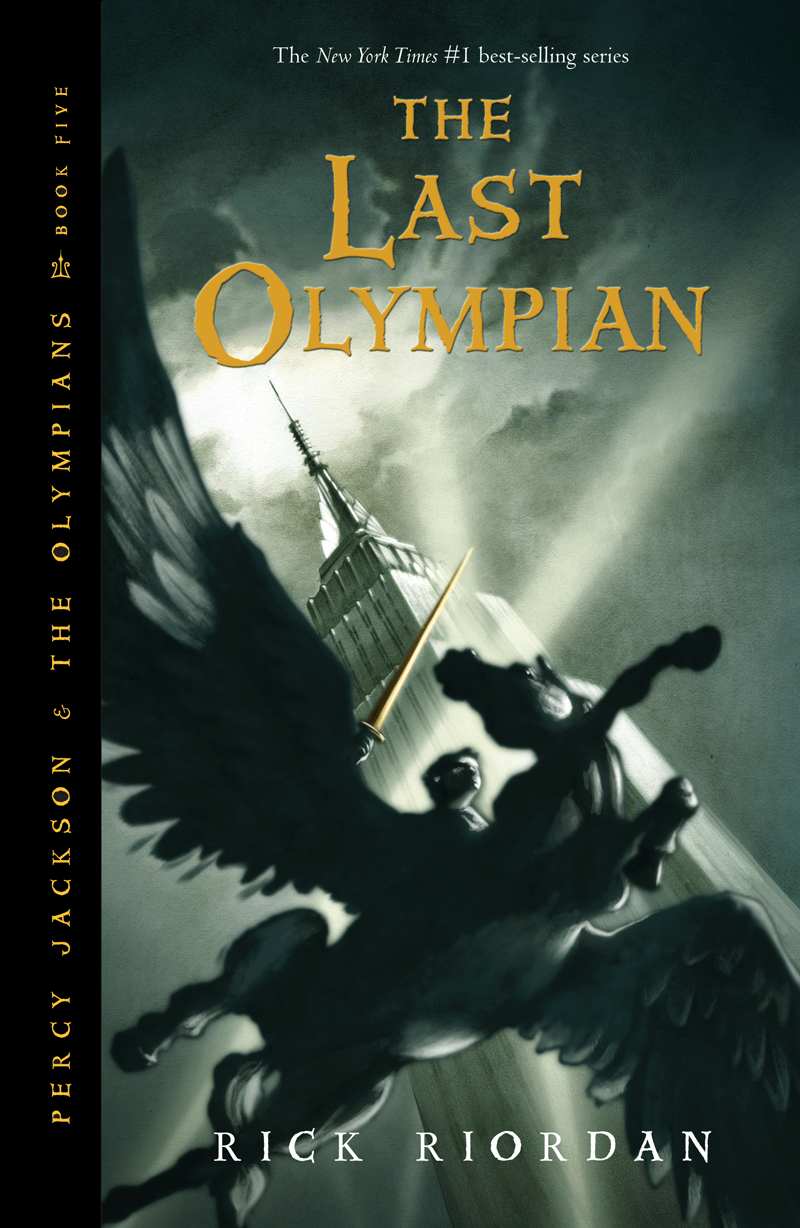 |
| The Last Olympian by Rick Riordan |
The fifth book begins with a bang, quite literally: In the first chapter, Percy and Beckendorf blow up a ship. Then, of course, it's straight to camp, where the demigods are preparing for a war that will decide the fate of both the Olympian world and the mortal one. All the gods (minus Poseidon, who is fighting his own war under the ocean) are locked in battle with the giant Typhon, and Kronos, now in Luke's body, is leading his army of monsters and half-bloods to an unprotected Mount Olympus. Percy's sixteenth birthday is in a week, and we all know what that means. The Great Prophecy is finally revealed to our favorite hero and all the rest of the campers, and boy, is it grim. Prophecies are never as they seem, but there's really no way to make what will happen on Percy's birthday sound anything but positively dreadful. Despite the fact that he's practically been handed a death sentence, Percy must lead the demigods of Camp Half-Blood to New York City, to protect the sources of the gods' powers on Olympus. They have little chance of success, and, to make matters worse, there is a spy among them. As the final battle approaches, Percy must make some important choices, unravel the past, and decide what really matters. With twists, turns, loves, deaths, and unexpected heroes galore, this best-selling series comes to an end no less spectacular than what we have come to expect from the talented Rick Riordan and his much-loved Percy Jackson.
Yeah. What I said right there at the end. Basically, it's perfect.
I can't express how much I love this finale. Everything, and I mean everything, comes together. The prophecy is revealed. Luke's past is revealed. Nico's life is pieced together. People live. People die. People trade sides and prove themselves and make their final stands. There is love, and happiness, and there are tearful goodbyes. You do not see it coming. It hits you like a speeding freight train and then proceeds to run you over (and it is a very long speeding freight train). You cannot get enough. You laugh, and you cry; you jump up and down in your overstuffed chair and squeal loudly at the mushy bits, and you curl up in a blanket with your cat and a mug of hot tea and wallow in your misery at the retributory bits. You read it over and over and over and over and over again. You love it like there's no tomorrow. I'm serious, here. I'm for cereal.
You want me to say it, don't you? Fine, I'll say it. The end is reminiscent of the end of Harry Potter and the Deathly Hallows. (There's another one of my favorite series; maybe I'll review it someday. For now: Read it!) It is, if you think about it, fairly similar, though like the series itself, everything in this book is to a slightly smaller scale. But that doesn't mean it's any less powerful. It is hugely powerful. And The Last Olympian is its own book, with its own story, its own characters, its own revelations, and its own resolution.
I'm not going to try to convince you to read this book. If you are at this point, if you have read all the previous books, I can't imagine being able to stop you from reading it, even if for some incomprehensible reason I wanted to. I am just telling you. It is worth it. This end is worth everything. The end of Percy Jackson and the Olympians is worth everything in the world.
I mean it.
Heck, if they get this far in the movies, I'd kill them for not making this into one.
Thank you to everyone, all of my friends and family members, for bearing with me through my time following this series, particularly there at the end. I know I can get a little over-enthusiastic at times, but you are nothing but supportive. I love you all!
And endless thanks go to Rick Riordan for writing the best series of all times, in my opinion. You have added such a wonderful thing to my life.
Finally, and most importantly, thank you to Percy Jackson. You, my dear friend, have been with me for years. I have followed you on your adventures, laughing and crying, and I have loved every minute of it. (I still do.) You have enriched my life. You are the best, and, in my eyes, you always will be. Keep in touch.
It has been an amazing era.
Recommendation: You. Yes, you. You know who you are.
Subscribe to:
Posts (Atom)